
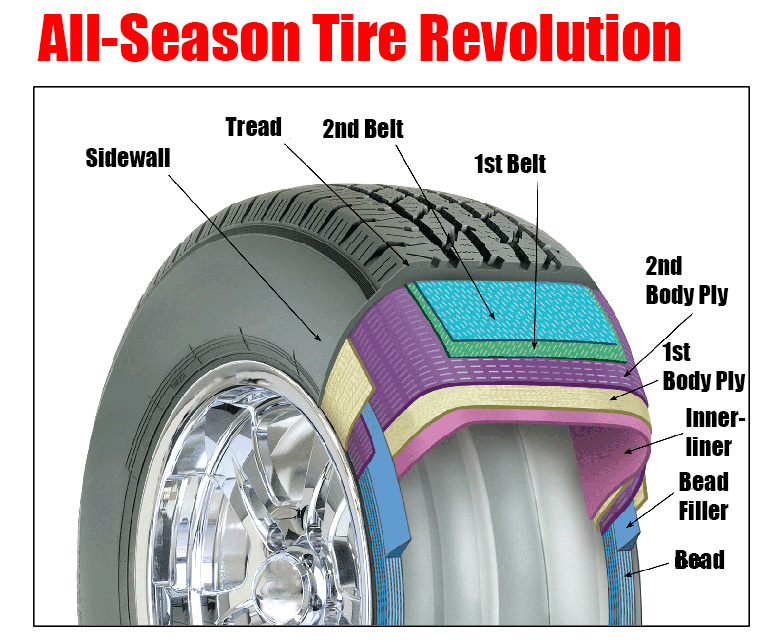
Tires are more than just a component of your vehicle; they are the critical link between you and the road. This link greatly impacts the driving experience, safety, and fuel efficiency of the vehicle. Among the various tire options available to drivers, all-season tires have revolutionized the way we drive by offering unique advantages.
This article aims to explore this revolution, delving deep into its inception, development, and how emerging technologies are shaping its future.
The Evolution of Tires: An In-depth Journey
A Look at Early Tire Designs: From Functionality to Comfort
The history of tires is a tale of constant innovation, driven by human ingenuity and the quest for better performance and comfort. The tire journey began in the early 19th century, with rudimentary designs that were essentially bands of iron or steel fitted to the wooden wheels of carriages and carts. This crude setup, although functional, provided a rather harsh and uncomfortable ride.
The first semblance of what we consider a tire today came into being when bands of solid rubber replaced the iron hoops. This transformation occurred in the mid-19th century, when rubber processing technology became sufficiently advanced. The use of rubber offered a significant improvement in terms of shock absorption, making travel smoother and less jarring.
Yet, these solid rubber tires were not without their shortcomings. They wore out quickly, struggled to maintain grip on slippery surfaces, and provided little in terms of cushioning against bumps and potholes. As useful as they were in ushering in a new era of transportation, the limitations of these early tire designs were starkly apparent, especially as faster and heavier vehicles emerged on the scene.
The Invention and Advancements of Pneumatic Tires: Revolutionizing Mobility
The landmark innovation in tire evolution came with the invention of the pneumatic, or air-filled, tire. The credit for this game-changing invention goes to John Boyd Dunlop, a Scottish veterinarian, who came up with the concept in 1887. Dunlop was trying to improve the comfort of his son’s tricycle ride, and his successful experiment with air-filled tubes encased in rubber led to the creation of the first practical pneumatic tire.
The advantages of Dunlop’s invention were evident. Pneumatic tires significantly enhanced ride comfort, provided better grip, and were more durable. They also reduced the strain on vehicle components, thanks to their improved shock-absorbing capacity.
As automobiles began to proliferate in the early 20th century, the demand for more durable, reliable, and comfortable tires grew. This need for enhanced performance led to an era of significant advancements in tire technology. Improvements in rubber compounds, the introduction of tread patterns, and the implementation of more rigorous manufacturing standards all contributed to the continual evolution of the pneumatic tire.
The next transformative innovation came with the development of the radial tire in the mid-20th century. Invented by Michelin, radial tires offered superior durability, handling, and fuel efficiency compared to the previously dominant bias-ply tires, quickly becoming the standard in tire design.
Today, we’re witnessing a new revolution in tire technology, driven by advancements in materials science, digital technology, and an increased focus on sustainability. This ongoing evolution of tire technology is not only reshaping our tires but also transforming the way we drive. The following chapters will delve deeper into the current state of the tire industry, focusing on the all-season tire revolution, and explore how emerging technologies are poised to drive future advancements.
The Emergence of All-Season Tires: Bridging the Gap
The Origin and Rationale of All-Season Tires: A Response to Diverse Weather Conditions
The concept of all-season tires emerged as a pragmatic response to the seasonal challenges faced by drivers. Born in the mid-20th century, around the 1970s, these tires aimed to fill a gap that conventional tire types couldn’t effectively address.
Before the advent of all-season tires, drivers had to resort to a biannual routine of tire changes. The summer months would see the usage of standard tires, while the winter months necessitated the use of snow tires to handle the frigid temperatures and slippery conditions. This constant swapping of tires was not just inconvenient, but also expensive, as it required owning two sets of tires and paying for the services of tire changeovers twice a year.
The goal of all-season tires was to free drivers from this cycle. The vision was to create a tire that could perform reliably across a variety of weather conditions, providing a good grip on both dry and wet roads, and being capable of handling light snow. The rationale was clear – a single set of tires that could eliminate the need for seasonal changeovers and provide year-round driving comfort and safety.
Early Challenges and Developments: Pioneering a Balance
Despite their clear benefits, the journey of all-season tires was far from smooth sailing. As with any pioneering product, the first generation of all-season tires faced significant technical challenges. The primary challenge was creating a tire that could balance the contradictory needs of different weather conditions.
Winter driving requires soft rubber compounds that stay flexible in cold temperatures, providing good grip on icy and snowy roads. On the other hand, summer driving demands harder rubber compounds that can withstand higher temperatures and resist wear on hot asphalt.
Striking a balance between these opposing needs was no small feat. It required a deep understanding of rubber chemistry and tire mechanics, as well as innovative thinking to devise solutions that could deliver a year-round performance. The tire industry’s answer was a new class of rubber compounds and complex tread designs that could adapt to varying temperatures and road conditions.
The development of these early all-season tires set the stage for the all-season tire revolution. It showed that it was possible to create a tire that could deliver reliable performance across diverse weather conditions. As tire technology advanced, these tires would continue to evolve, offering even better performance, greater comfort, and improved safety, ultimately transforming the way we drive. The story of this transformation is what we will explore in the following chapters.
The Anatomy of All-Season Tires: Engineering a Masterpiece
Tread Design: A Fine Balance Between Flexibility and Stability
One of the defining features of all-season tires is their sophisticated tread design. This design has to strike a delicate balance between two seemingly contrasting requirements — stability for dry pavement grip, and flexibility for handling wet and snowy conditions.
Large, stable tread blocks are necessary for providing grip and stability on dry pavement. They ensure the tires have sufficient contact with the road, thus enabling the vehicle to handle high-speed maneuvers and sudden braking effectively. This is particularly critical during the summer months when temperatures soar, and the asphalt can get scorching hot.
On the other end of the spectrum, the tread design also needs to cater to winter conditions. Here, the focus is on enhancing the tire’s flexibility to handle snowy and wet surfaces. The design incorporates numerous sipes and grooves that provide multiple biting edges, improving traction on slippery surfaces. This balance between stability and flexibility is the secret behind the all-season tire’s ability to perform reasonably well across a wide range of conditions.
The Role of Rubber Compounds: The Secret Sauce
The rubber compounds used in all-season tires are nothing short of a technological marvel. These compounds are the result of rigorous scientific research and are carefully engineered to deliver superior performance over a broad range of temperatures.
From the sweltering heat of summer to the bone-chilling cold of winter, these rubber compounds stay flexible, providing the tire with the adaptability it needs to handle different weather conditions. The precise composition of these compounds also plays a crucial role in various performance aspects of the tire, such as grip, tread wear, and rolling resistance.
The grip of a tire is vital for vehicle control and safety. The rubber compounds need to provide sufficient friction to ensure good traction on various surfaces. At the same time, they also need to be durable to withstand wear and tear, ensuring the tire lasts long and provides consistent performance. Finally, the compounds also need to balance fuel efficiency by minimizing rolling resistance, which is the force that a tire needs to overcome to roll on the surface.
Understanding Siping and Grooves: The Art of Traction
Sipes and grooves are integral features of an all-season tire’s tread design. They are carefully crafted into the tread to enhance traction and improve the tire’s performance in wet and snowy conditions.
Sipes are small slits that are cut across the tire’s tread. When the tire comes in contact with a slippery surface, these sipes open up to provide additional biting edges, increasing the tire’s grip on the surface. This is particularly beneficial in winter conditions, where the sipes help the tire latch onto icy or snowy surfaces, reducing the chances of skidding.
Similarly, grooves are channels cut into the tire’s tread to help expel water from beneath the tire. By doing so, they reduce the risk of hydroplaning — a dangerous situation where the tire loses contact with the road and skates on a film of water. The efficient removal of water ensures the tire maintains good contact with the road, improving traction and safety.
Modern all-season tires feature complex patterns of sipes and grooves, each designed with a specific purpose in mind. Some help improve grip on snow, others enhance wet traction, and some even help reduce noise. By incorporating these features into their design, all-season tires can deliver optimal all-weather performance, revolutionizing the driving experience.
Weighing the Benefits and Limitations of All-Season Tires: The Art of Compromise
Versatility and Convenience: The All-Season Advantage
The most significant advantage of all-season tires is their sheer versatility. These tires are meticulously designed to deliver balanced performance across a variety of road and weather conditions. From summer’s heat to winter’s chill, from dry asphalt to rain-soaked streets, all-season tires are engineered to handle it all with reasonable proficiency.
This versatility translates into a high degree of convenience for drivers. No longer do they have to deal with the hassle of switching tires with the changing seasons. Gone are the days of storing away winter tires in summer or scrambling to get snow tires mounted as winter approaches. With all-season tires, drivers have a one-size-fits-all solution that provides adequate performance year-round.
The convenience extends beyond the mere act of changing tires. It also means drivers do not need to worry about finding storage space for their off-season tires. Plus, it spares them from the additional costs associated with buying two sets of tires and having them mounted and balanced twice a year.
Limitations: The Winter and Summer Extremes
However, as with anything that aims to be a jack-of-all-trades, all-season tires have their limitations. The very compromises that allow them to operate across a wide range of conditions prevent them from excelling at the extremes.
When it comes to extreme winter conditions, all-season tires cannot match the performance of dedicated winter tires. Winter tires are specially designed with softer rubber compounds that stay flexible in cold temperatures, and aggressive tread patterns that grip snow and ice effectively. In contrast, while all-season tires can handle light to moderate snow, they may struggle in severe snow or ice conditions.
Similarly, on the other end of the spectrum, all-season tires cannot deliver the same level of performance on hot pavement as summer tires. Summer tires, with their specialized tread patterns and rubber compounds, offer superior traction and handling in warm weather, particularly during high-speed driving. This becomes clear when look at the test results of Michelin CrossClimate 2 on RadialZone – the tire has been performing at the top on most of the tire tests featuring only all-season tires, but when it was included to a test of summer tires, it performed worse than any other tire on the test.
Thus, while all-season tires offer adequate performance across a range of conditions, they might not be the best choice for drivers who regularly encounter extreme weather or who engage in high-performance driving. It’s important for drivers to understand these limitations and make an informed decision based on their specific driving conditions, requirements, and preferences.
Also, while all-season tires are highly versatile, they are not designed for off-road conditions. Drivers who frequently drive on unpaved roads or trails may need to consider all-terrain or mud tires, which are specially designed to handle rough surfaces and provide maximum traction.
Minding the Middle Ground: The Best of Both Worlds
The key to understanding all-season tires lies in recognizing that they are designed for the middle ground. They may not excel in extreme conditions, but they do provide a comfortable, safe, and reliable driving experience across most typical driving conditions.
For many drivers, especially those living in regions with mild weather, all-season tires are a practical choice. They offer the perfect balance between performance, longevity, and cost-effectiveness, making them a great all-round option.
In the end, the choice of tires should be dictated by the driver’s individual needs, preferences, and driving conditions. If the convenience and cost-effectiveness of a single set of tires outweigh the benefits of specialized seasonal tires, all-season tires are an excellent choice. But for those who regularly drive in extreme weather or off-road conditions, dedicated seasonal or specialized tires might be a better fit.
How Technology Drives the All-Season Tire Revolution: Pushing Boundaries
The Influence of Material Science: More Than Just Rubber
Material science has played a pivotal role in revolutionizing all-season tires. As the science behind rubber compounds has evolved, so too has the quality and performance of these tires. Today’s all-season tires are the result of decades of research and development in materials science.
Modern tires are far more than just rubber. They are sophisticated composites, using blends of synthetic and natural rubber, fabric, and wire. Carbon black and other chemical compounds are incorporated to enhance various attributes of the tire. These could range from improved durability, to better performance, to increased fuel efficiency.
Advanced material science is also employed to tackle one of the biggest challenges in all-season tire design: balancing the need for low rolling resistance (which improves fuel efficiency) with the need for excellent wet grip (which is crucial for safety). State-of-the-art materials and tread designs work hand in hand to meet these dual objectives.
Developments in material science have also led to the creation of innovative rubber compounds that remain flexible over a wide temperature range. This flexibility ensures that all-season tires maintain their grip, whether in the heat of summer or the cold of winter.
The Power of Computer-Aided Design and Manufacturing: Precision and Control
In the digital age, tire design and manufacturing processes have seen significant changes. Computer-aided design (CAD) software enables designers to model and optimize everything from tread patterns and sidewall designs to internal tire structures. The technology allows for simulations under a variety of conditions, providing insights into how a particular design or material choice will perform in real-world conditions.
Beyond the design stage, computer-aided manufacturing (CAM) brings these intricate designs to life with a level of precision and control that was previously unimaginable. With CAM, manufacturers can create complex tire structures, incorporating different materials in different parts of the tire to optimize performance.
These high-tech design and manufacturing processes have revolutionized the tire industry. They have made it possible to create tires with a complex balance of characteristics, each fine-tuned to perform a specific role. The result is all-season tires that deliver reliable performance across a variety of conditions, without compromising on safety or fuel efficiency.
The Impact of Big Data and AI: A Glimpse into the Future
One emerging area of technology that holds immense potential for the future of all-season tires is the use of big data and artificial intelligence (AI). By analyzing large volumes of data on tire performance under various conditions, AI can help in identifying patterns and insights that can guide the design of future tires.
For instance, machine learning algorithms can be trained to predict how different rubber compounds or tread patterns will perform based on historical data. This could expedite the design process and lead to the development of more advanced and efficient all-season tires.
In conclusion, technology is the driving force behind the all-season tire revolution. From advances in material science to the adoption of digital design and manufacturing techniques, and the potential application of big data and AI, the future of all-season tires looks promising and exciting.
Groundbreaking Innovations in All-Season Tires: Elevating Performance and Safety
Advanced Tread Patterns and Siping: Traction Revolutionized
Innovation in tread design has significantly improved the performance of all-season tires. Advanced tread patterns feature optimized block designs and groove placements, leading to better traction, improved water expulsion, and ultimately, longer life. Whether on a dry summer road or a rain-soaked highway, these novel tread patterns ensure dependable grip and handling.
Further pushing the envelope is the evolution in siping technology. Modern all-season tires incorporate 3D siping and active siping, offering superior grip and control in various weather conditions. 3D sipes add an extra layer of depth to the tire tread, enhancing block stability without compromising on wet traction. Active sipes, on the other hand, adjust to different road conditions, expanding in cold conditions for improved snow grip and contracting in warm weather to increase stability.
Smart Wear Indicators: The Future of Tire Maintenance
Tire maintenance has been transformed with the advent of smart wear indicators. These have evolved from simple tread wear bars to sophisticated systems that provide drivers with accurate and timely information about tire wear. Some modern tires now feature variable-depth sipes that serve as built-in tread life indicators, altering their shape or disappearing entirely as the tire wears down.
These advanced wear indicators can provide drivers with a more precise assessment of when tire replacement is necessary, enhancing road safety. They also have the potential to save drivers money by preventing premature tire replacement. Smart wear indicators represent a significant step forward in the ongoing effort to make tires safer and more user-friendly.
The Rise of Run-Flat Technology: Safety Meets Convenience
Run-flat technology has seen a substantial increase in popularity in recent years, particularly in all-season tires. This technology enables a tire to continue performing even after losing air pressure, providing a crucial safety buffer in the event of a puncture.
Initially designed with safety in mind, run-flat technology also offers tangible benefits in terms of convenience and space-saving. By allowing drivers to continue their journey to a safe location or service station following a puncture, run-flat tires eliminate the immediate need for a roadside tire change. Additionally, they make the need for a spare tire redundant, freeing up valuable space in the vehicle.
This combination of safety, convenience, and space efficiency underscores why run-flat technology represents a significant innovation in the all-season tire landscape. Its adoption continues to grow as more drivers recognize and appreciate its benefits.
The Advent of Self-Sealing Tires: Next-Gen Puncture Resistance
Another innovation that’s beginning to make its mark is the development of self-sealing tires. These all-season tires are designed with an inner lining that can instantly seal punctures, effectively reducing the impact of tire damage.
The technology involves a layer of sealant material inside the tire that flows into punctures to seal them, often so effectively that the driver may not even realize they’ve had a puncture. It’s another step forward in ensuring uninterrupted journeys and enhancing overall road safety.
Through these groundbreaking innovations, the all-season tire revolution continues to gather pace, with each new development promising greater safety, better performance, and more convenience for drivers. The future of all-season tires is indeed bright and promising.
The Environmental Impact of All-Season Tires: A Commitment to a Sustainable Future
Improving Fuel Efficiency through Low Rolling Resistance: Maximizing Energy Efficiency
The drive towards sustainability has been a significant motivator behind recent tire technology advancements. One of the most notable developments is the production of all-season tires with lower rolling resistance. This attribute essentially refers to the amount of energy lost as a tire rolls down the road. By reducing this loss, tires can help improve a vehicle’s fuel efficiency.
Lower rolling resistance is achieved through several design elements, including the use of advanced rubber compounds, optimised tread designs, and innovative internal tire structures. These technical achievements offer two key benefits. Firstly, they contribute significantly to improved fuel efficiency, a critical factor given the increased environmental consciousness among modern drivers. By reducing the amount of energy a car needs to move, these tires decrease fuel consumption, resulting in lower CO2 emissions.
Secondly, tires with lower rolling resistance also translate into cost savings for drivers. As these tires help improve a vehicle’s miles-per-gallon performance, they lead to less frequent fuel fill-ups, saving money in the long run. This combination of environmental responsibility and economic efficiency makes low rolling resistance a key selling point for all-season tires.
Sustainable Tire Manufacturing Practices: Building a Greener Tire Industry
The tire industry’s commitment to sustainability extends well beyond the performance characteristics of the tires themselves. Increasingly, manufacturers are embracing more sustainable practices throughout the entire tire life cycle.
To start with, the industry has been making concerted efforts to use more sustainable materials in the production of all-season tires. This includes the integration of renewable materials like natural rubber, bio-based fillers, and even recycled rubber. Some manufacturers are even researching the potential to replace petroleum-based materials with alternatives derived from organic waste, which could dramatically reduce the carbon footprint of tire production.
Simultaneously, efforts are being made to reduce waste during the tire manufacturing process. Techniques such as lean manufacturing and waste-to-energy programs are being adopted industry-wide. By optimizing processes and reducing production waste, these measures help to conserve resources and decrease the environmental impact of tire manufacturing.
Finally, end-of-life tire management has become a critical focus area. Improving the recyclability of tires and expanding the market for recycled tire products are key objectives. By developing new methods to recycle and repurpose used tires, the industry is making significant strides in reducing landfill waste and promoting a circular economy.
These eco-friendly advancements are not just beneficial for the environment, but they also contribute to the overall appeal of all-season tires for environmentally-conscious consumers. In an era where sustainability is becoming a prime consideration, the tire industry’s commitment to green practices enhances the value proposition of all-season tires.
Future Trends: What’s Next for All-Season Tires? Unfolding the Roadmap
The Role of Big Data and AI in Tire Development: Precision and Performance
As we look towards the future of all-season tire technology, one cannot ignore the increasing influence of Big Data and Artificial Intelligence (AI). These powerful tools are making their presence felt across various industries, and tire manufacturing is no exception.
In the realm of tire development, Big Data and AI have significant potential. By harnessing vast amounts of data about tire performance under a myriad of conditions, manufacturers can employ machine learning algorithms to derive insights that humans may overlook. This allows for more sophisticated modeling and simulation of tire performance, effectively reducing the time and cost of development while enhancing precision and accuracy.
AI can be used to perform complex simulations, testing the impact of minor alterations in tire composition or design before these changes are physically implemented. This not only accelerates the design process but also lowers costs by minimizing the need for physical prototypes and lengthy testing periods.
Furthermore, AI can enable predictive modeling, allowing manufacturers to explore new tire design concepts and make more precise predictions about how these designs will perform in real-world conditions. This ability to forecast performance can dramatically enhance the efficiency of the design process and help manufacturers stay ahead of the curve in terms of innovation.
Smart Tires: The Future of Driving is Responsive
In the not-too-distant future, the concept of “smart” tires promises to redefine the driving experience. Building upon the advancements in sensor technology and connectivity, smart tires are equipped with sensors that monitor their own condition, as well as the environment around them.
These tires can provide real-time feedback to the driver or to the vehicle’s control system. This could include critical information about tire pressure, temperature, wear, and even road conditions. For instance, by continuously monitoring tread wear, a smart tire could alert drivers when it’s time for a replacement, long before traditional wear bars become visible.
Furthermore, smart tires have the potential to relay information about road conditions by analyzing variations in traction, temperature, and other factors. This could provide advanced warning about slippery roads, potholes, or other hazards, greatly improving safety and performance.
Smart tires also hold promise in the realm of autonomous vehicles. As self-driving technology continues to evolve, the need for accurate, real-time information about tire performance and road conditions becomes even more vital. In this context, smart tires could provide essential data that informs the vehicle’s control system, enabling it to make real-time adjustments to improve safety, performance, and efficiency.
The emergence of smart tires, therefore, symbolizes the convergence of tire technology with the broader trends in the automotive industry, pointing towards a future where tires are not merely passive elements but active contributors to a safer, more efficient, and more enjoyable driving experience.
Conclusion: The All-Season Tire Revolution Rolls On: A Journey of Innovation and Evolution
From their humble beginnings to their status as a staple in most vehicles today, all-season tires have embarked on a remarkable journey of transformation. No longer the simple rubber circles of yesteryears, they have evolved into sophisticated pieces of engineering that fuse material science, mechanical design, and even digital technology.
These tires have consistently enhanced the driving experience, marrying safety and efficiency with the convenience of year-round performance. Each development, each innovation has been a step towards making driving safer, more efficient, and more enjoyable, no matter the weather conditions.
But the tire industry does not rest on its laurels. Driven by a constant thirst for improvement, it continues to innovate and evolve. Manufacturers now leverage emerging technologies to further refine and enhance the capabilities of all-season tires. The influence of advanced material science, digital design tools, and automation is palpable, and the impending influence of big data, AI, and connectivity promises even more exciting developments on the horizon.
The advent of smart tires, with their ability to monitor and communicate their status and the road conditions, marks the beginning of a new chapter in this ongoing revolution. Tires are moving beyond being mere points of contact between the vehicle and the road. They are becoming intelligent, interactive elements that contribute actively to the safety and performance of the vehicle.
As drivers, we are more than just witnesses to this revolution; we are active participants. Our demands for safety, performance, convenience, and sustainability drive the evolution of tire technology. We’re experiencing a revolution that is transforming not just our tires, but the way we drive, and by extension, the way we live.
This ongoing revolution in all-season tire technology is about more than just tires. It symbolizes our relentless quest for progress, our refusal to compromise between convenience and performance, and our determination to make every journey safer and every destination closer. It’s not just about changing tires – it’s about driving forward into the future of mobility, with confidence, excitement, and anticipation.
Thus, as we look towards the horizon, it’s clear that the revolution is far from over. The road ahead is full of possibilities, and the journey promises to be as exciting as the destinations it will lead us to. The all-season tire revolution rolls on, and we’re all invited to come along for the ride.