
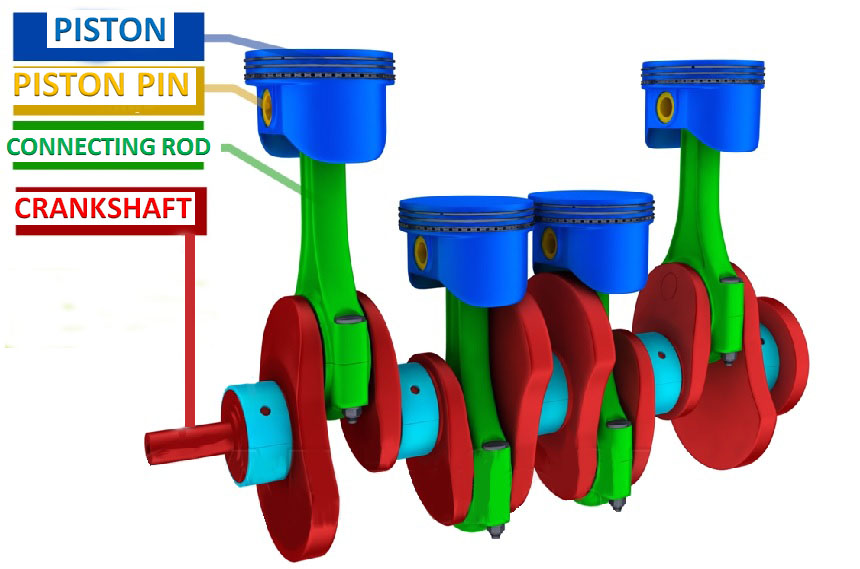
The purpose of crank mechanism is transforming back-and-forth motion of the pistons to the crankshaft rotation.
Components of crank mechanism can be divide on two groups: stationary and moving.
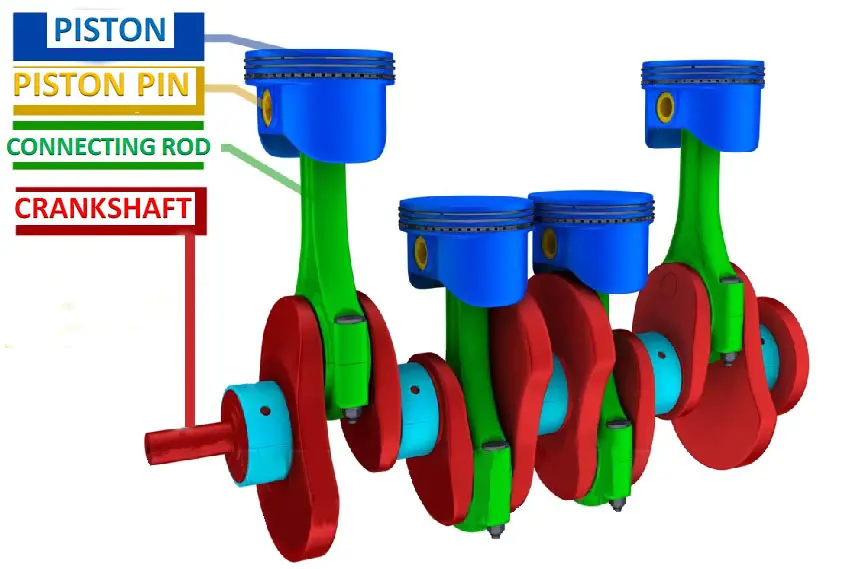
Moving components of crank mechanism: pistons, piston rings, piston pins, connecting rods, crankshaft, flywheel.
Stationary components of crank mechanism: engine cylinder block, engine head block, sump, cylinders.

Piston – is a component of internal combustion engine. Purpose of piston is to transfer force from expanding gas in the cylinder to the crankshaft through a connecting rod.

Piston rings – is a split ring that fits into a groove on the outer diameter of a piston in an internal combustion engine.

Connecting rod – is a member, which connects a piston to a crankshaft in a reciprocating engine.

Crankshaft – is a mechanical part performs a conversion between reciprocating motion piston and connecting rod to rotational motion. When crankshaft defecting is not possible to avoid costly repair, so you can see crankshaft repair cost here.

Flywheel – is a mechanical device designed to efficiently store crankshaft rotational energy.

Engine cylinder block – is the structure, which contains the cylinders, and other parts, of an internal combustion engine.

Engine cylinder head – sits above the cylinders on top of the cylinder block in an engine.

Cylinder – is the central working part of an engine, the space in which a piston travels.
