
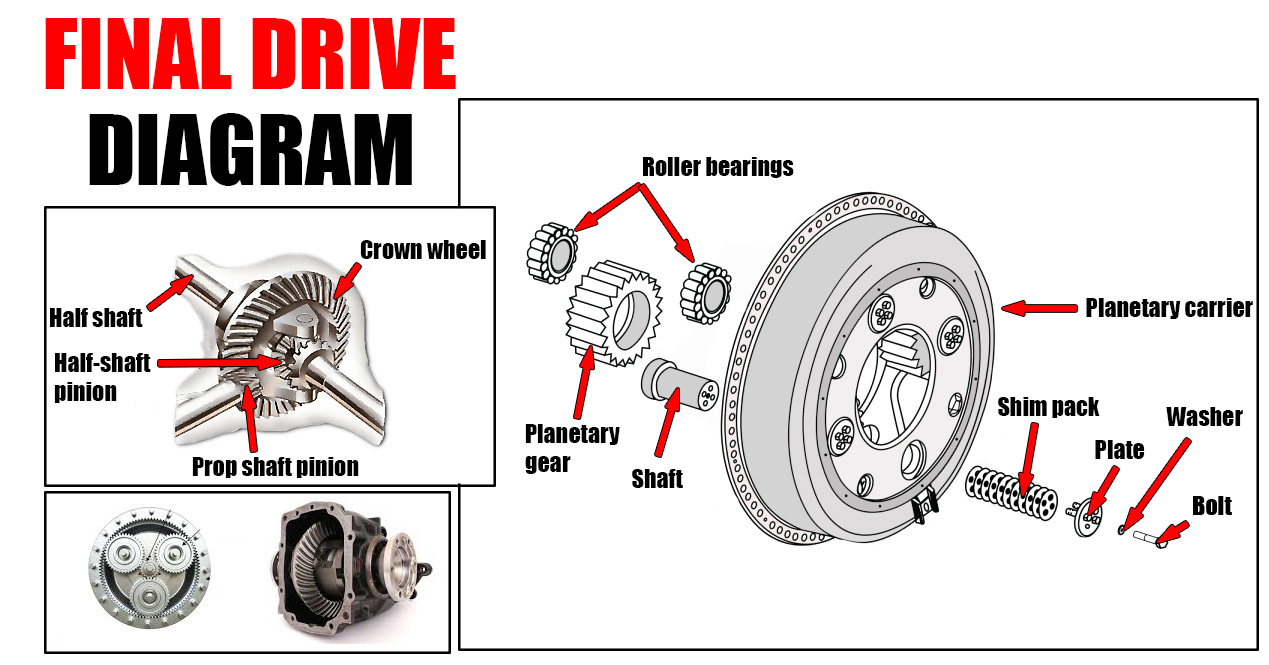
The final drive gear assembly is a crucial component in the powertrain of a vehicle, serving as the last stage of gear reduction before power is transmitted to the wheels. This assembly plays a vital role in adjusting the rotational speed and torque, ensuring that the wheels receive the optimal amount of force for propulsion.
Purpose and Functionality
The primary purpose of the final drive assembly is to reduce the engine’s revolutions per minute (RPM) while simultaneously increasing the rotational torque delivered to the wheels. This reduction is necessary because, in most driving conditions, the wheels do not need to rotate as quickly as the engine. Typical final drive ratios range from 3:1 to 4.5:1, meaning that for every three to four and a half revolutions of the engine, the wheels complete one revolution. This gear reduction allows for smoother acceleration and more efficient power delivery, particularly when the transmission is in an overdrive gear.
Connection to the Differential
The final drive assembly is intricately connected to the vehicle’s differential, another essential component of the drivetrain. The propeller shaft, which transmits power from the transmission to the rear axle, is attached to a pinion gear that enters the differential housing. This pinion gear is aligned with a larger crown wheel, which is responsible for driving the half shafts that connect to the rear wheels.
Gear Mechanics Inside the Differential
Within the differential housing, beveled pinion gears interact with the crown wheel, ensuring that power is evenly distributed to both rear wheels. These gears allow the wheels to rotate at different speeds, which is particularly important during cornering. When a vehicle turns, the outer wheel must travel a greater distance than the inner wheel, necessitating a higher speed. The differential accommodates this difference, allowing for smooth and controlled cornering by enabling one wheel to turn faster than the other.
The final drive gear assembly is a critical component that ensures efficient power transmission from the engine to the wheels. By reducing RPM and increasing torque, it provides the necessary force for vehicle propulsion. Its integration with the differential allows for smooth and stable vehicle handling, particularly during cornering, making it an indispensable part of the modern automotive drivetrain.