
Universal Joints
Universal joints, often referred to as U-joints, are critical components in automotive and mechanical systems that allow for the transmission of rotary motion between shafts that are not in a straight line. One of the most commonly used types of universal joints is the Hooke joint, named after the 17th-century scientist Robert Hooke. This joint plays a pivotal role in various applications, particularly in the automotive industry, where it is essential for the smooth transmission of power from the engine to the wheels.
The Hooke Joint: Structure and Function
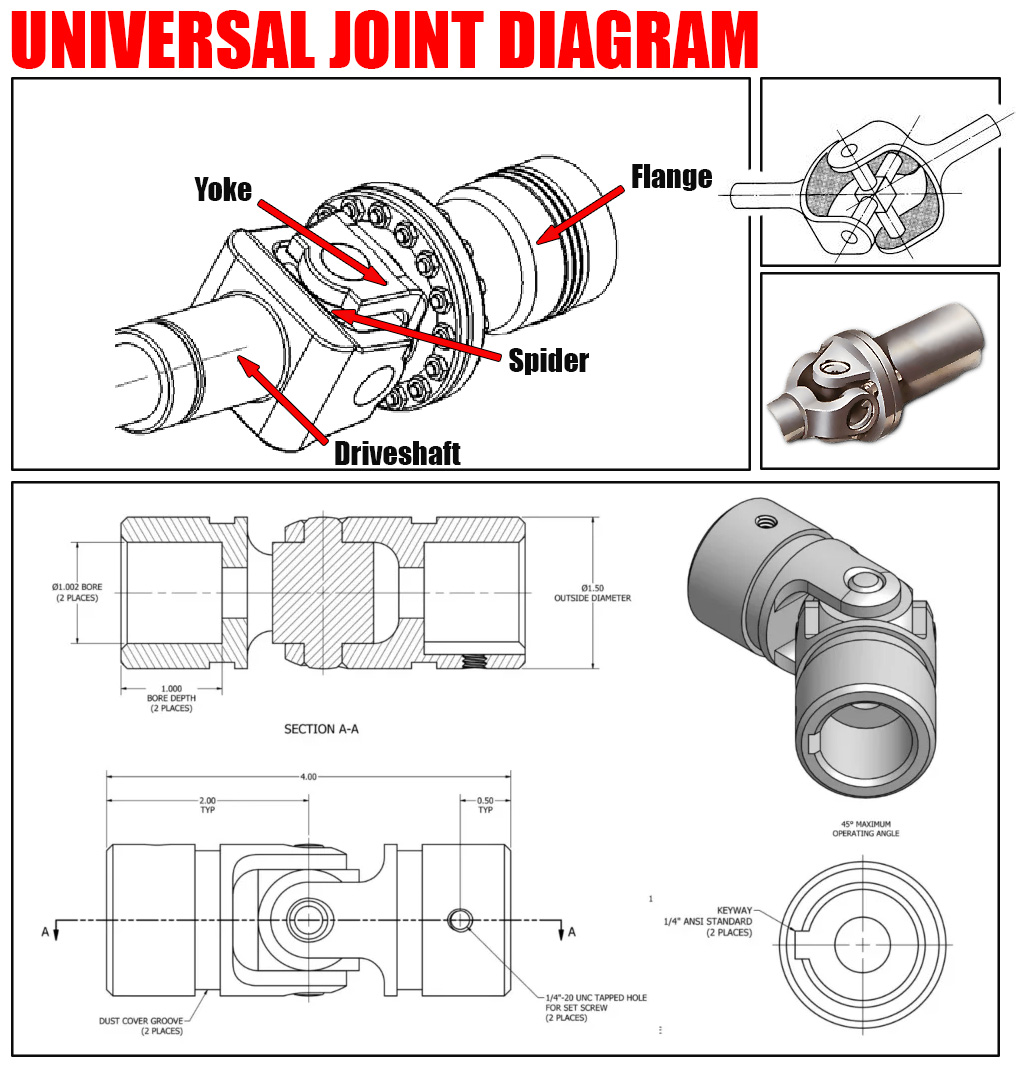
The Hooke joint is characterized by its cross-shaped central component, often referred to as the ‘spider.’ This spider is the key element that connects the two shafts, enabling the transfer of motion even when the shafts are at an angle to each other. The spider itself operates on needle-roller bearings, which are designed to minimize friction during operation. These bearings are crucial as they allow the joint to accommodate the angular misalignment between the shafts while maintaining efficient power transmission.
Interaction with the Drive Shaft
In an automotive context, the Hooke joint is typically found in the drive shaft, which transmits power from the engine to the differential. The differential is responsible for distributing this power to the rear wheels of the vehicle. One of the critical interactions within this system involves the crown wheel and the pinion gear. The crown wheel usually possesses approximately four times the number of teeth as the pinion gear. This gear ratio is essential because it ensures that the rear wheels rotate at a quarter of the speed of the propeller shaft. This reduction in speed is necessary to provide the appropriate torque required to drive the vehicle forward efficiently.
Transmission of Power to the Rear Wheels
The power transmitted by the drive shaft does not reach the rear wheels directly. Instead, it is channeled through half shafts or drive shafts, which are connected to the differential. At the differential end of each half shaft, a bevelled pinion gear is used to engage with the crown wheel. The connection between these gears is facilitated by an intermediate set of bevel pinions, which ensures that the power is evenly distributed between the two rear wheels. This arrangement allows the vehicle to maintain traction and stability, particularly when navigating turns, as the differential compensates for the difference in distance traveled by the inner and outer wheels.

The universal joint, particularly the Hooke joint, is a fundamental component in the mechanical transmission systems of vehicles. Its ability to transmit power efficiently between misaligned shafts is critical for the proper functioning of automotive drivetrains. Understanding the structure and operation of the Hooke joint, along with its interaction with the drive shaft, crown wheel, and pinion gears, provides valuable insights into the complexities of vehicle mechanics. As automotive technology continues to evolve, the principles governing the design and operation of universal joints remain integral to ensuring the reliability and performance of modern vehicles.