
Worm Gear at the Steering Column Base
At the base of the steering column, a worm gear is housed within a casing. The worm gear resembles a threaded cylinder, much like a short bolt. When you turn the worm gear, it functions similarly to turning a bolt with a nut on it—the nut moves along the bolt’s thread. In the steering system, this rotational motion of the worm gear causes a connected component to move within the thread.
Moving Components Based on Design
The moving component can differ based on the steering-box design. It might be a sector gear, a peg or roller attached to a fork, or a large nut. In a worm-and-peg setup, the worm gear moves the drop arm via a peg linked to a fork.
Recirculating-Ball System
In a recirculating-ball system, the nut has hardened balls within the thread between the worm gear and the nut. As the nut moves, these balls circulate through a tube that brings them back to the beginning of the thread.
Linkage to the Steering Arms
The worm gear’s motion drives the drop arm, which is connected by a track rod to a steering arm that controls the closest front wheel. A central track rod extends to the opposite side of the vehicle, where another track rod and steering arm link to the other front wheel. The far end of the central track rod is stabilized by a pivoted idler arm. The exact configuration of these arms can vary depending on the vehicle.
Precision and Wear in the Steering-Box System
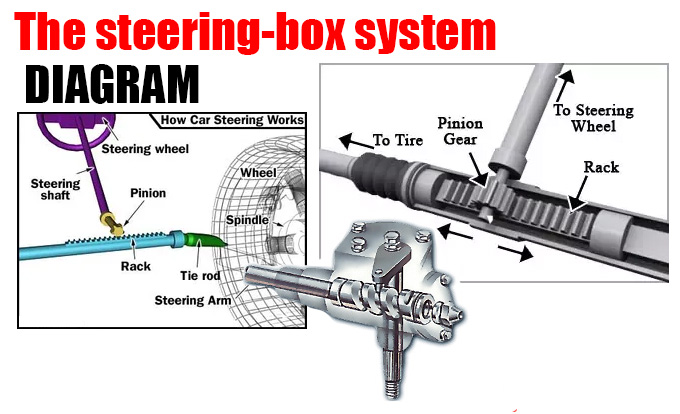
This steering-box system has multiple moving components, which makes it less precise than a rack-and-pinion system. The increased number of parts introduces more potential for wear and misalignment, leading to less accurate steering.