
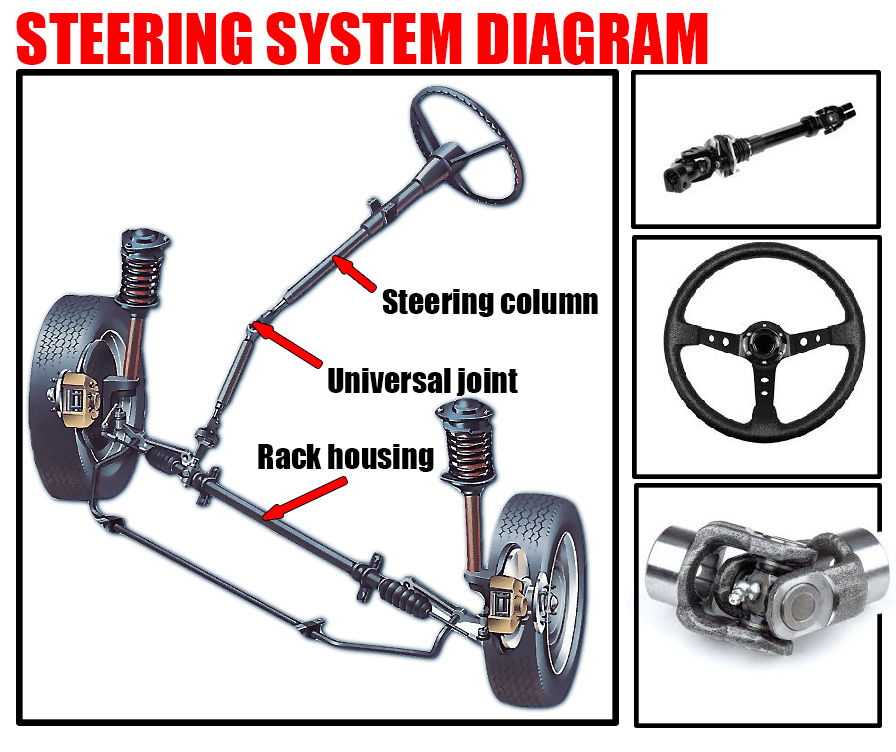
Steering System
The steering system is fundamental to vehicle control, translating the driver’s input at the steering wheel into the precise movement of the road wheels. It ensures that even minimal effort applied to the steering wheel can maneuver a heavy car efficiently. For instance, turning the steering wheel four full rotations might move the wheel’s rim nearly 16 feet, but the actual movement of the road wheels is only about 12 inches. This system allows drivers to steer without having to exert excessive force.
Rack-and-Pinion Steering
The rack-and-pinion system is a popular steering mechanism due to its simplicity and precision. At the core of this system is the pinion, a small gear wheel located at the base of the steering column. This pinion meshes tightly with a straight row of teeth on a rack, which is a long bar running horizontally across the car.
When the driver turns the steering wheel, the pinion rotates and moves the rack from side to side. The ends of the rack are connected to the road wheels via track rods, which control the wheels’ direction. This design has very few moving parts, making it highly accurate and less prone to wear over time. Additionally, a universal joint in the steering column ensures that the steering wheel remains comfortably positioned without angling awkwardly.

The Steering-Box System
The steering-box system operates differently from the rack-and-pinion setup. At the base of the steering column, a worm gear—essentially a threaded cylinder—sits inside a box. When the worm gear is turned, it moves a corresponding part fitted into its thread. Depending on the design, this moving part could be a gear sector, peg, roller, or a large nut.
In the recirculating-ball variant of this system, the nut and worm gear are filled with small balls. As the nut moves along the worm gear, these balls circulate within a tube, returning to the start in a continuous loop. This design minimizes friction and wear, enhancing the system’s durability.
The worm gear moves a drop arm connected to a track rod, which then adjusts the position of the nearest front wheel. A central track rod extends across to the opposite side of the car, linking to the other front wheel via another track rod and steering arm. To maintain stability, a pivoted idler arm holds the far end of the central track rod level. While effective, the steering-box system has more moving parts than the rack-and-pinion setup, making it slightly less precise due to the potential for wear and displacement.
Power-Assisted Steering
Power-assisted steering is a feature found in many modern vehicles, especially heavier models, to make steering easier. Without power assistance, steering a heavy car could be challenging, particularly at low speeds or when parking in tight spaces. The power-assist system uses the engine to drive a pump, which supplies high-pressure oil to either the rack or the steering box.
When the driver turns the steering wheel, valves in the steering rack or box open, allowing the pressurized oil to enter a cylinder. This oil pressure works on a piston that helps push the steering in the desired direction. Once the driver stops turning the wheel, the valve closes, and the piston ceases its assistance. Importantly, the power-assist feature does not replace the mechanical link between the steering wheel and the road wheels; it only aids the driver in steering.
Ensuring Precision in Steering
The steering system relies on a network of pivoted joints to transmit the driver’s steering input to the road wheels. These joints are crucial as they allow the wheels to move up and down with the suspension while maintaining the correct steering angle. Properly adjusted joints ensure that when the vehicle turns, the inner front wheel, which needs to follow a tighter curve than the outer one, angles more sharply. Even a small amount of looseness in these joints can lead to dangerously imprecise steering, making regular maintenance and adjustment critical.
Whether utilizing a rack-and-pinion or steering-box system, modern vehicles often incorporate power-assisted steering to enhance driving comfort and control. Both systems have their merits, with rack-and-pinion offering precision and simplicity, while the steering-box system provides robust durability. Proper maintenance of the steering components is essential for safe and accurate vehicle handling.