
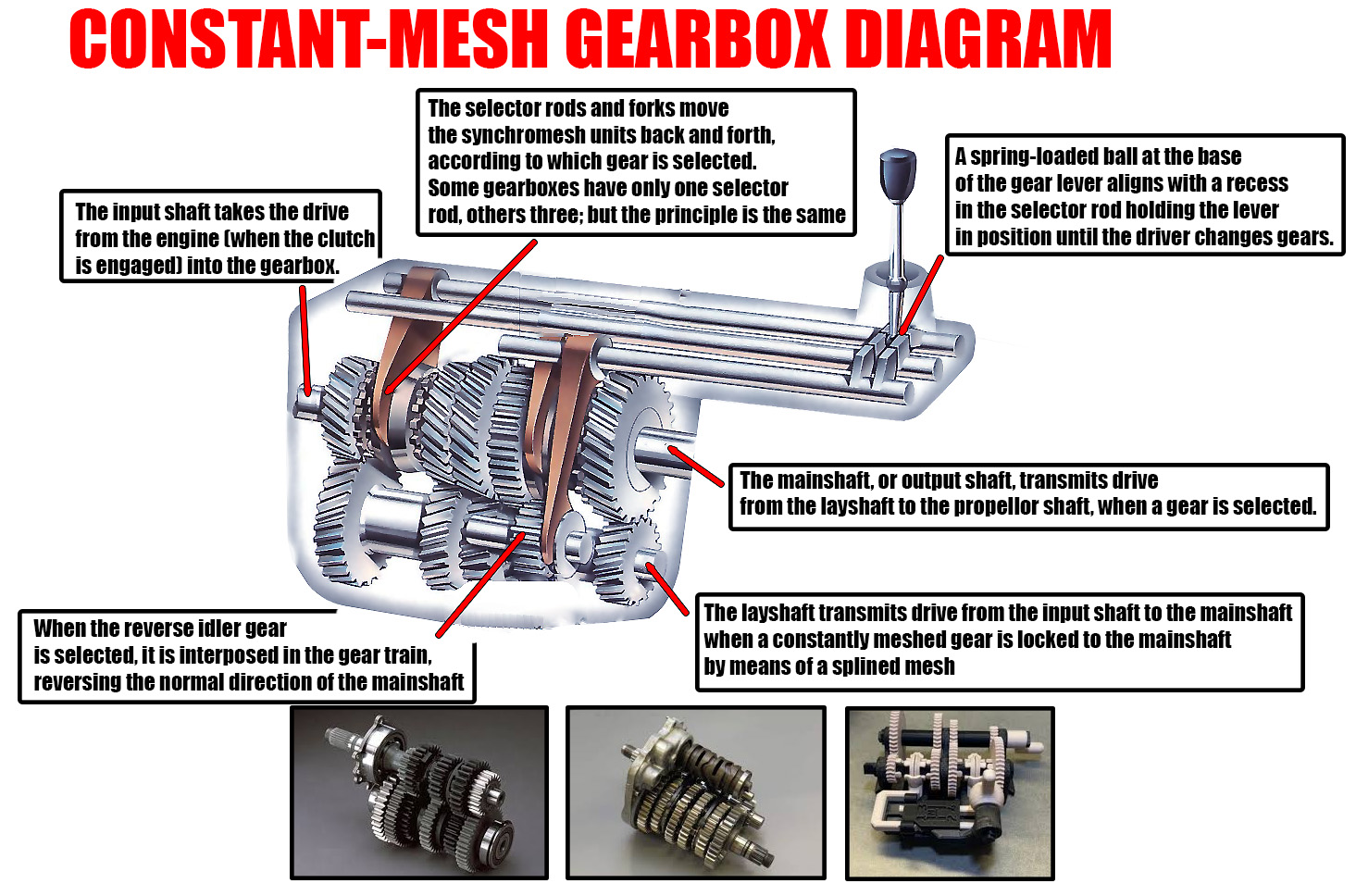
A constant-mesh gearbox is designed with gears that are always engaged, but the selection of the gears is managed through a sophisticated system of rods and levers connected to the gear lever. When a driver chooses a gear, the corresponding gear pair is locked to the shaft, allowing power to be transmitted through the input shaft to the layshaft, and then to the mainshaft. In this system, every gear except the top gear (direct drive) transfers power through this pathway. In direct drive, however, the input shaft and the mainshaft are directly connected, bypassing the layshaft for a more efficient power transfer.
Constant-Mesh Gearbox
The constant-mesh gearbox is an essential component in a vehicle’s transmission system, positioned right after the clutch and typically mounted at the rear of the engine. In modern manual transmissions, you’ll find four or five forward gears and a reverse gear, along with a neutral position.
Gear Engagement and Operation

In a constant-mesh gearbox, gears are in constant engagement, but they rotate freely on the mainshaft until selected by the driver. The system consists of three main shafts: the input shaft, layshaft, and mainshaft, all supported by bearings within the gearbox casing. The engine powers the input shaft, which in turn drives the layshaft. The layshaft then causes the gears on the mainshaft to rotate, but these gears remain idle until the synchromesh device locks them to the shaft.
Role of the Synchromesh Device
The synchromesh device plays a crucial role, ensuring smooth gear changes by synchronizing the speeds of the engaging gears. When the driver selects a gear, the synchromesh, controlled by a selector rod, engages the chosen gear by moving it along the mainshaft. The baulk ring, a vital part of the synchromesh, delays gear engagement until the shaft speeds are perfectly matched, preventing gear clash.
Overdrive Gear for Economic Driving
In some vehicles, an overdrive gear is included, providing an additional, higher gear ratio beyond the top gear, which allows for more economical driving at cruising speeds.
4o