
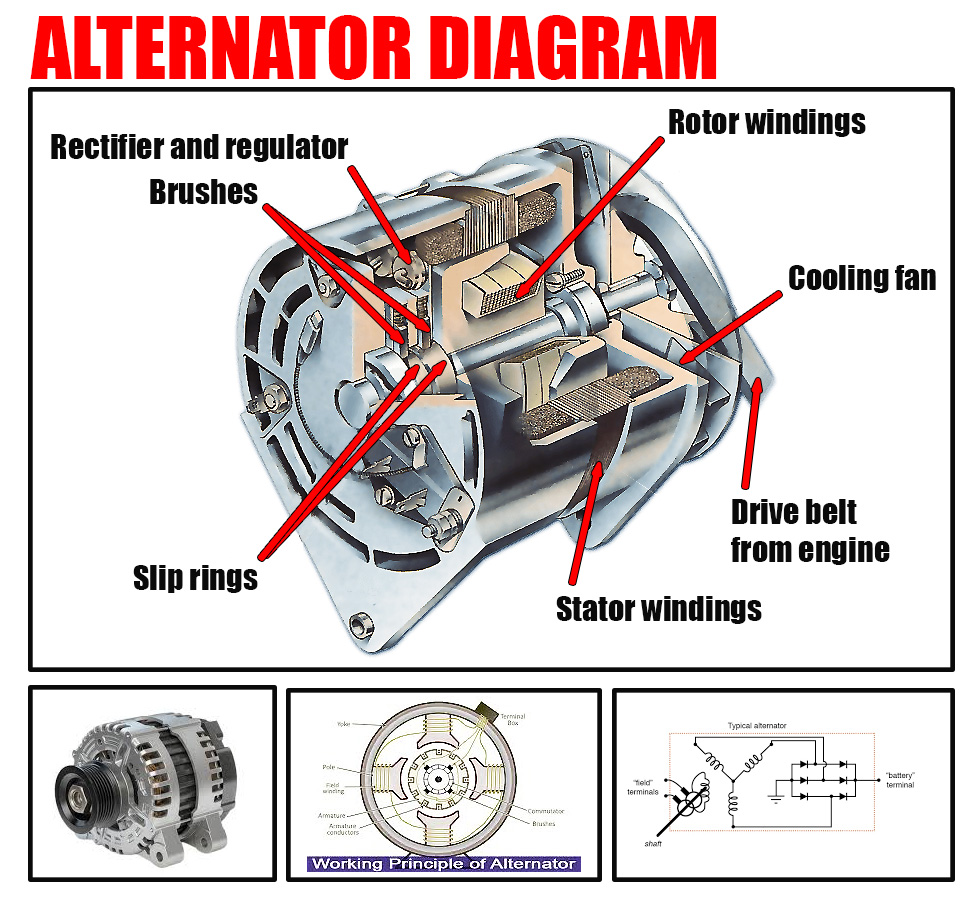
Alternator System
A car relies heavily on electricity to power the ignition system and various electrical components. If all the energy came solely from a conventional battery, it would quickly deplete. To prevent this, vehicles are equipped with a rechargeable battery and a charging system that ensures the battery remains sufficiently charged.
How the Battery Works
The car battery contains pairs of lead plates submerged in a mixture of sulfuric acid and distilled water. Each terminal of the battery is connected to half of these plates. When electricity is supplied to the battery, a chemical reaction occurs that deposits additional lead onto one set of plates. Conversely, when the battery provides electricity to the car, the extra lead dissolves from the plates, generating an electric current.
The Role of the Alternator
In modern cars, the battery is charged by an alternator, a type of generator driven by a belt connected to the engine. The alternator is composed of a stator, which is a stationary set of wire coil windings, and a rotor, an electromagnet that rotates within the stator. The rotor receives a small amount of electricity through brushes (typically made of carbon or copper-carbon) that maintain contact with two rotating metal slip rings on the rotor’s shaft.
Generating and Rectifying Electricity
As the rotor spins within the stator coils, it generates electricity within these coils. The electricity produced by the alternator is alternating current (AC), meaning the direction of flow reverses each time the rotor completes a turn. However, the car’s electrical system requires direct current (DC), so the AC must be rectified—converted into a one-way flow—before it can be used.
Differences Between Alternators and Dynamos
Earlier cars used a dynamo to charge the battery, which directly produced DC. However, dynamos are less efficient, especially at low engine speeds, and are heavier than alternators. This is why modern vehicles use alternators for their charging systems.
Monitoring the Charging System
Most vehicles are equipped with a warning light on the dashboard that illuminates when the battery isn’t being adequately charged, such as when the engine is off. Some cars also have an ammeter to indicate the amount of electricity being generated or a battery-condition indicator to show the battery’s charge level.