

Leaf Springs
Leaf springs are one of the oldest and most enduring types of suspension systems used in vehicles. Known for their simplicity and durability, leaf springs are commonly found in a variety of vehicles, from classic cars to modern trucks. This article provides a detailed overview of the design, operating principles, and advantages of leaf springs, with particular emphasis on their role in vehicle suspension systems and ride quality.
The Basic Structure of a Leaf Spring
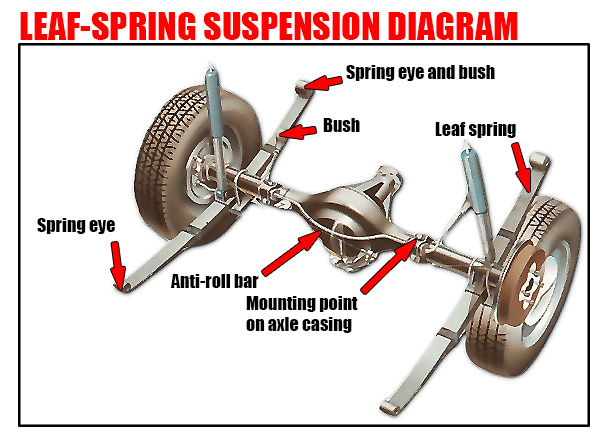
A leaf spring is made up of several strips of steel, known as leaves, which are stacked on top of each other. The longest and topmost strip is called the master leaf. The master leaf is crucial because it is curled at each end to form eyes, which are used to connect the spring to the vehicle’s frame. The leaves beneath the master leaf are progressively shorter and less curved, forming a stack that works together to provide suspension.

As the vehicle encounters a bump, the leaf spring deflects, or bends, to absorb the impact. When this happens, the spring flattens out, and the lower leaves make contact with the leaves above them. This progressive engagement of the leaves causes the spring to become stiffer, allowing it to handle the increased load more effectively. This design enables a smoother ride compared to what could be achieved with a single, stiff leaf.
How Leaf Springs Function in Vehicle Suspension
Leaf springs are fixed to the vehicle’s axle using U-bolts that clamp the center of the stack of steel strips. When the spring deflects due to the weight of the vehicle or road conditions, the leaves flatten out, increasing their contact with one another. This flattening action stiffens the spring, allowing it to better support the load and maintain vehicle stability.
As the leaves flatten, the overall length of the spring increases slightly. To accommodate this change in length, one end of the leaf spring is connected to the vehicle’s frame via a pivoted shackle. This shackle allows the spring to extend and retract smoothly as it compresses and decompresses, preventing undue stress on the spring and maintaining proper alignment with the vehicle’s axle.
Progressive Stiffness and Ride Quality
One of the key advantages of leaf springs is their ability to provide progressive stiffness. This means that the spring becomes stiffer as it compresses more, which helps in handling different loads and road conditions. When the vehicle is lightly loaded, only the master leaf and perhaps the second leaf are engaged, providing a softer ride. As the load increases, more leaves come into contact, increasing the stiffness and improving the vehicle’s ability to carry heavier loads without compromising ride quality.
Variations in Leaf Spring Design
While traditional multi-leaf springs are still widely used, some modern vehicles have adopted a single-leaf spring design. These springs are typically made from a single piece of steel that is tapered in section. Despite being a single piece, these springs can offer progressive stiffness similar to that of multi-leaf springs. The tapered design allows the spring to flex more at the ends and less in the center, providing a balance between softness and strength.
Advantages and Applications of Leaf Springs
Leaf springs are a fundamental component of many vehicle suspension systems, offering a combination of simplicity, durability, and effective load management. Their design provides progressive stiffness characteristics, contributing to improved ride comfort and enhanced handling under varying load conditions. Whether used in traditional multi-leaf assemblies or modern mono-leaf configurations, leaf springs remain an essential component of vehicle suspension systems, delivering reliable performance across a wide range of automotive applications.