
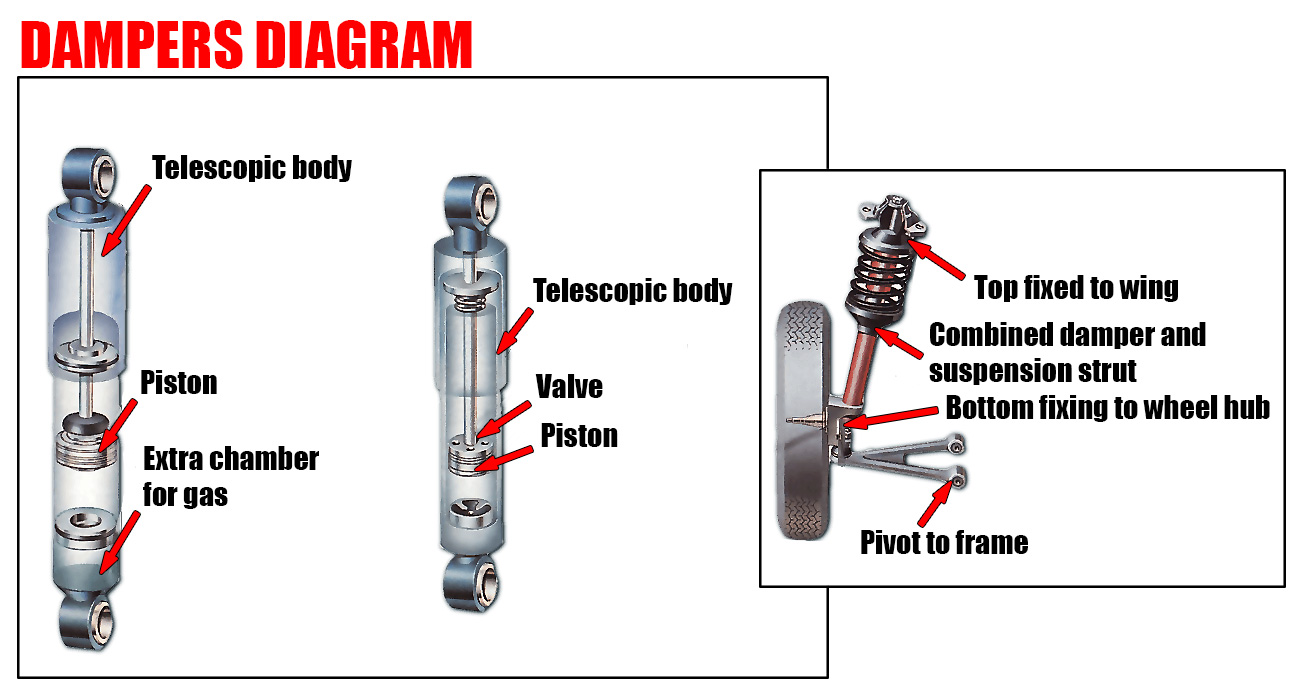
Dampers, often referred to as shock absorbers, are crucial components in a vehicle’s suspension system. They play a vital role in controlling the oscillations of the car’s springs, ensuring a smooth and stable ride. Without dampers, a car would continue to bounce after encountering a bump, as the energy stored in the springs would have no way to dissipate. This article provides a detailed exploration of how dampers work, their different types, and their role in modern vehicle suspension systems.
The Function of Dampers in Vehicle Suspension
When a car travels over a bump, the springs in the suspension system compress and then rebound, causing the vehicle to bounce. If left uncontrolled, this bouncing would continue, leading to an uncomfortable ride and potentially compromising vehicle control. Dampers are designed to counteract this by dissipating the energy stored in the springs.
A damper consists of a piston that moves inside a sealed, oil-filled cylinder. As the wheel moves up and down, the piston is forced to move within the cylinder. The piston contains narrow control passages and one-way valves that allow oil to flow from one chamber to another, but this flow is deliberately restricted to slow down the movement. This controlled movement of oil through the piston dampens the spring oscillations, gradually bringing the vehicle back to a stable and level ride.
Types of Dampers
There are several types of dampers, each designed to meet different vehicle requirements and suspension configurations. The most common types include telescopic dampers, strut inserts, and lever-arm dampers.

Telescopic Dampers
Telescopic dampers are perhaps the most widely recognized type. They resemble a telescope in both appearance and function, extending and shortening as needed to absorb shocks. One end of the telescopic damper is bolted to the axle, while the other is attached to the vehicle body. As the wheel encounters a bump, the damper shortens, forcing the piston to move and oil to pass through the piston’s control passages. This action slows the wheel’s movement, effectively damping the oscillation and restoring a smooth ride.
Strut Inserts
Strut inserts are similar in function to telescopic dampers but are specifically designed to fit within a MacPherson strut, a common suspension component in many modern vehicles. The MacPherson strut combines the functions of a shock absorber and a suspension strut, with the damper unit being a crucial part of the overall assembly. The strut insert works in the same way as a telescopic damper, controlling the movement of the suspension and ensuring vehicle stability.
Lever-Arm Dampers
Lever-arm dampers differ in design from the telescopic and strut types. They resemble hydraulic door closers and consist of one or two pistons housed within a cylinder. The damper is fixed to the car body or frame, and a pivoted lever extends from the damper to the axle. As the wheel moves, the lever pivots, causing the piston to move within the cylinder. This movement forces oil through control passages, damping the motion of the suspension.
Oil and Gas-Filled Dampers
In addition to traditional oil-filled dampers, some modern vehicles are equipped with dampers that contain both oil and gas. These gas-filled dampers are designed to perform more efficiently by providing additional resistance to the piston movement. The gas, usually nitrogen, is stored in a separate chamber within the damper. As the piston moves, the gas compresses, providing extra damping force that further slows the movement and enhances vehicle stability.
Dampers are essential to the performance and safety of a vehicle, ensuring that the energy from road impacts is effectively managed and dissipated. By controlling the oscillations of the springs, dampers provide a smooth and stable ride, enhancing both comfort and control. Understanding the different types of dampers and their functions is key to appreciating the complexity and sophistication of modern vehicle suspension systems.