
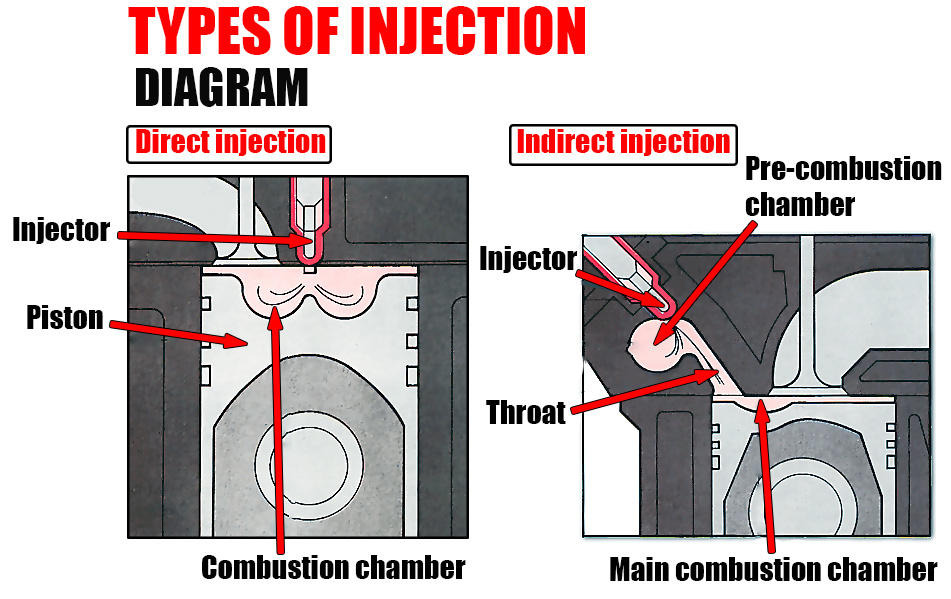
Efficient operation of an internal combustion engine relies on the precise mixing of fuel and air. This process is particularly challenging in diesel engines, where fuel and air are introduced at different stages of the cycle and must be mixed inside the cylinders. To address these challenges, two main types of fuel injection systems are employed: direct injection and indirect injection.
Direct Injection
In direct injection systems, fuel is injected directly into the combustion chamber, which is located at the top of the piston crown. This method eliminates the need for a swirl chamber, allowing the fuel to mix directly with the compressed air in the cylinder. The main advantage of direct injection is its potential for improved fuel efficiency and power output. However, achieving the correct fuel-air mix is challenging, as improper mixing can lead to incomplete combustion and the characteristic diesel “knock.” Engineers must carefully design the combustion chamber to create sufficient turbulence, ensuring efficient fuel atomization and mixing.
Indirect Injection
Indirect injection is a more traditional approach where fuel is injected into a small swirl chamber (or pre-combustion chamber) before it reaches the main combustion chamber. The swirl chamber is designed to create turbulence, which helps mix the fuel with the highly compressed air in the combustion chamber. This turbulence ensures that the fuel burns more completely, reducing emissions and improving engine smoothness.
However, the drawback of indirect injection lies in the shape of the combustion chamber. Because the swirl chamber is effectively part of the combustion chamber, the overall shape becomes irregular. This irregularity can lead to combustion inefficiencies, as the fuel-air mixture may not burn as uniformly as it does in a direct injection system.

Both direct and indirect injection systems have their advantages and drawbacks. Direct injection offers greater efficiency and power but requires precise engineering to manage fuel-air mixing. Indirect injection provides a simpler solution for mixing fuel and air but can suffer from combustion inefficiencies due to the irregular shape of the combustion chamber. Understanding these differences is key to selecting the right injection system for a specific engine design and application.