
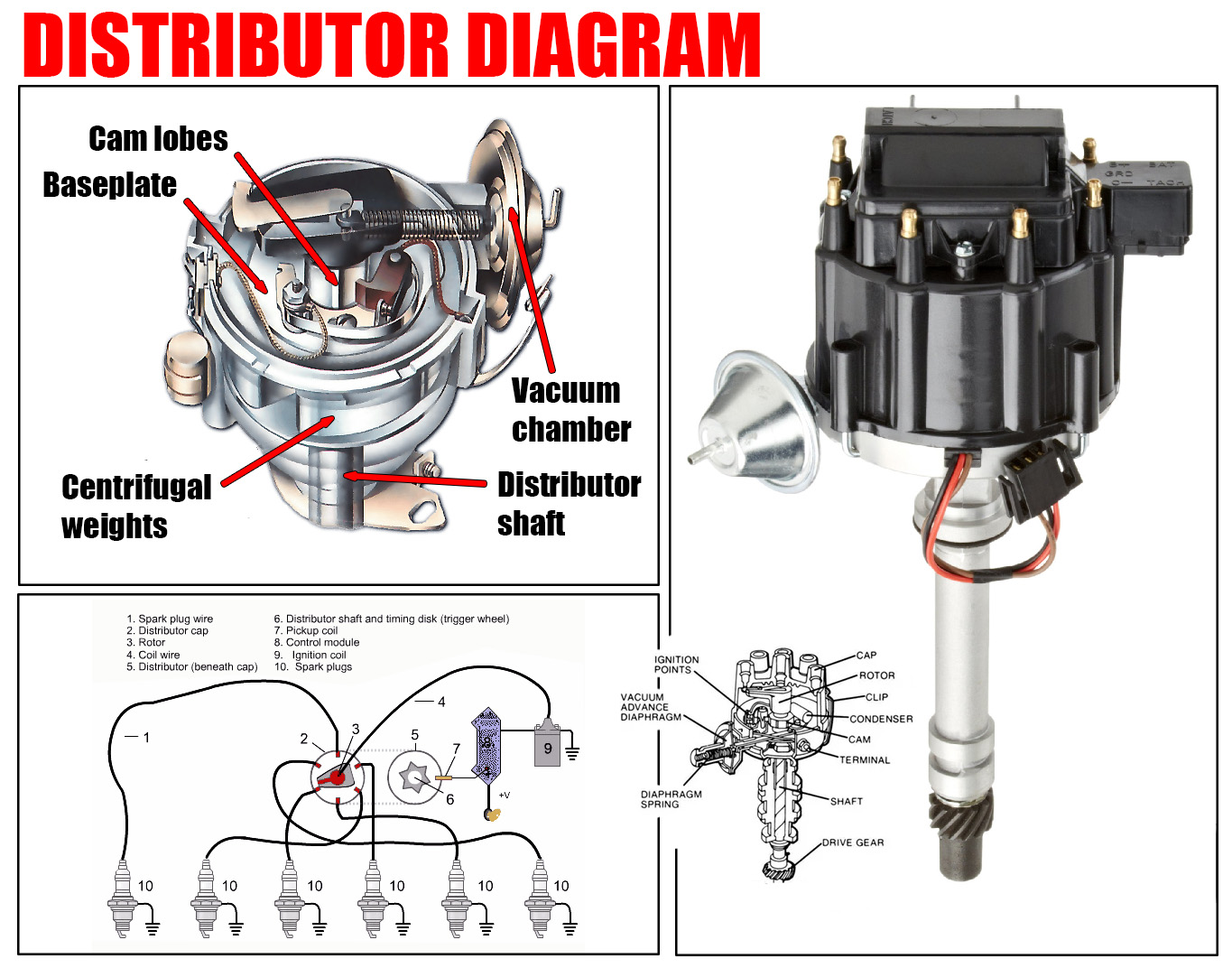
Distributor Diagram: Ignition Timing Mechanisms
For an internal combustion engine to operate efficiently, precise timing of the ignition process is crucial. The distributor plays a key role in managing this timing, ensuring that the fuel-air mixture in each cylinder ignites at the optimal moment. Below, we explore the key components and mechanisms involved in distributor operation.
The Importance of Precise Ignition Timing
To maximize engine performance, the fuel-air mixture in each cylinder must ignite at just the right moment—typically as the piston reaches the top dead center (TDC). However, ignition is not instantaneous. It takes a certain amount of time for the spark plug to ignite the mixture and for combustion to occur. Interestingly, this combustion time remains relatively consistent regardless of engine speed.
How Timing is Managed by the Distributor
Given that the time required for combustion is relatively fixed, the timing mechanism must be calibrated to account for engine speed. The spark plug is typically fired slightly before the piston reaches TDC to ensure that combustion pressure builds up optimally as the piston starts its downward movement. Without adjustment, as engine speed increases, the spark would ignite too late, leading to inefficiencies.
To prevent this, the distributor includes a mechanical device designed to advance the timing of the spark as engine speed increases. This ensures that the spark plug fires earlier at higher speeds, maintaining optimal combustion timing.
The Role of Engine Load in Ignition Timing

Beyond engine speed, the load on the engine—whether it is under heavy acceleration or cruising at a steady pace—also impacts the ideal ignition timing. A lightly loaded engine operates more efficiently with slightly advanced ignition timing. To accommodate this, a second mechanism within the distributor, typically vacuum-operated, adjusts the timing independently based on engine load. This allows for fine-tuning of ignition timing, further enhancing engine efficiency under varying conditions.
The distributor’s ability to adjust ignition timing both for engine speed and load is essential for optimal engine performance. By advancing the timing as needed, the distributor ensures that the fuel-air mixture ignites at precisely the right moment, maximizing power and efficiency across a wide range of operating conditions.