
The pushrod engine, also known as the overhead valve (OHV) engine, is a classic internal combustion engine configuration that has been widely used in automobiles for decades. This article explores the design, operation, and advantages of pushrod engines, explaining how they function and why they remain popular in certain applications despite the advent of newer technologies.
The Basics of Pushrod Engine Design
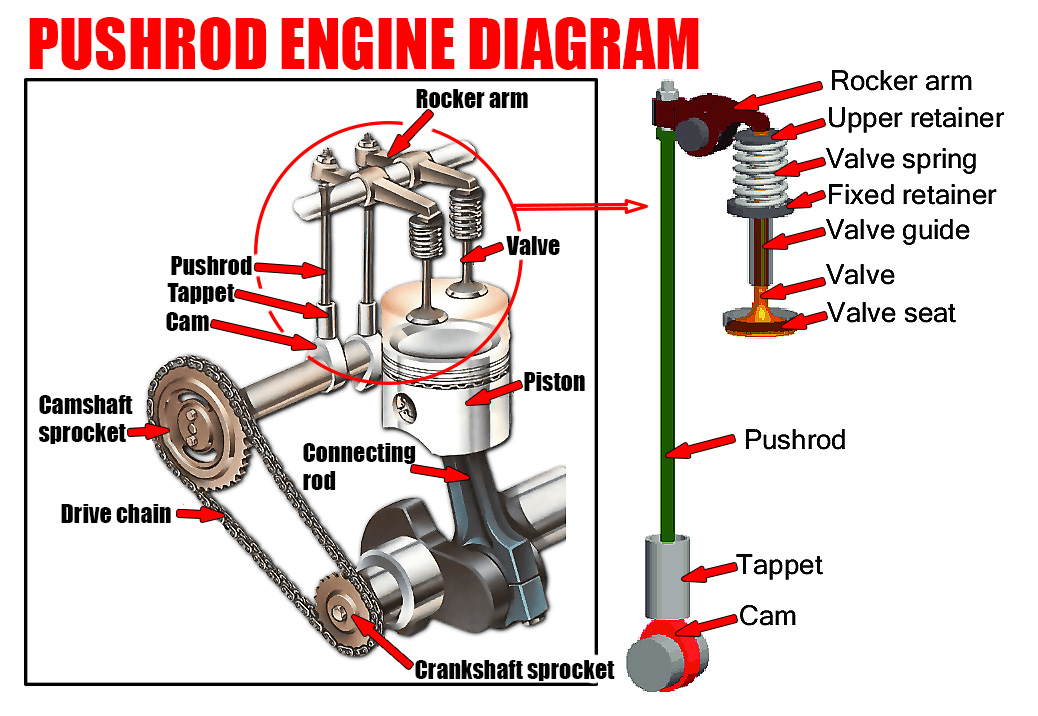
In a pushrod engine, the camshaft is located within the engine block, adjacent and parallel to the crankshaft. This positioning is a key characteristic of the overhead valve system. The camshaft’s role is to control the timing of the engine’s valves, which are situated in the cylinder head above the combustion chamber.
As the crankshaft rotates, it drives the camshaft via a timing chain. The camshaft’s lobes push against tappets (or lifters), which are positioned between the camshaft and the pushrods. The pushrods are long, slender rods that transfer the motion from the tappets up to the rocker arms located in the cylinder head.
Operation of the Pushrod System
The operation of the pushrod engine involves a sequence of precise mechanical movements:

- Camshaft Rotation: As the engine runs, the crankshaft turns the camshaft. The camshaft’s timing is crucial, and it is driven by a timing chain connected to the crankshaft. The sprocket on the camshaft has twice as many teeth as the crankshaft sprocket, ensuring that the camshaft rotates at half the speed of the crankshaft. This relationship is essential for proper valve timing.
- Tappet Activation: As the camshaft rotates, its lobes push against the tappets. The tappets are in direct contact with the camshaft and convert the rotational motion into linear motion.
- Pushrod Motion: The tappets then push the pushrods upward. The pushrods are essential components that transmit the linear motion from the tappets to the rocker arms.
- Rocker Arm Movement: At the top end, the pushrods connect to rocker arms, which pivot on a shaft or stud. As the pushrods move up, the rocker arms pivot, causing one end to push down on the valve stem, opening the valve.
- Valve Operation: The downward motion of the rocker arm opens the intake or exhaust valve, allowing the engine to take in air and fuel or expel exhaust gases. After the camshaft lobe passes, the valve spring pushes the valve back into the closed position, ready for the next cycle.
Advantages of Pushrod Engines
Pushrod engines offer several advantages, particularly in certain types of vehicles and applications:
- Compact Design: Because the camshaft is located within the engine block rather than in the cylinder head, pushrod engines can be more compact in height. This lower profile allows for a more compact engine design, which can be beneficial in vehicles where space is limited, such as trucks and certain muscle cars.
- Simpler Construction: Pushrod engines have fewer moving parts in the cylinder head, as there are no overhead camshafts or timing belts. This simplicity can lead to easier maintenance and lower production costs, making these engines more affordable to produce and repair.
- High Low-End Torque: Pushrod engines are known for producing high torque at low engine speeds (RPMs). This characteristic makes them particularly well-suited for applications where low-end power is important, such as in trucks and performance vehicles designed for straight-line acceleration.
- Durability and Longevity: The robust design of pushrod engines, with their simpler valve train, often leads to greater durability and longevity, especially in heavy-duty applications. This durability is a key reason why pushrod engines are still favored in certain types of vehicles, such as pickup trucks and commercial vehicles.
Comparison with Overhead Camshaft Engines
While pushrod engines have many advantages, they also have some limitations compared to overhead camshaft (OHC) engines:
- Higher RPM Capability: OHC engines can typically achieve higher engine speeds (RPMs) due to the reduced mass in the valve train. This makes OHC engines more suitable for high-performance applications where maximum power output is desired.
- More Complex Valve Timing: OHC engines can offer more precise valve timing and greater flexibility in valve operation, which can lead to improved engine efficiency and performance, particularly at high speeds.
- Weight Distribution: The design of OHC engines allows for better weight distribution in the engine, which can contribute to better handling and performance in vehicles designed for high-speed driving.
The pushrod engine, with its overhead valve system, remains a popular and reliable choice in many automotive applications. Its compact design, simplicity, and ability to deliver strong low-end torque make it a preferred engine type for trucks, muscle cars, and other vehicles where these characteristics are valued. While overhead camshaft engines may offer advantages in high-performance settings, the pushrod engine continues to hold its own in the automotive world, providing durability, ease of maintenance, and consistent performance.