
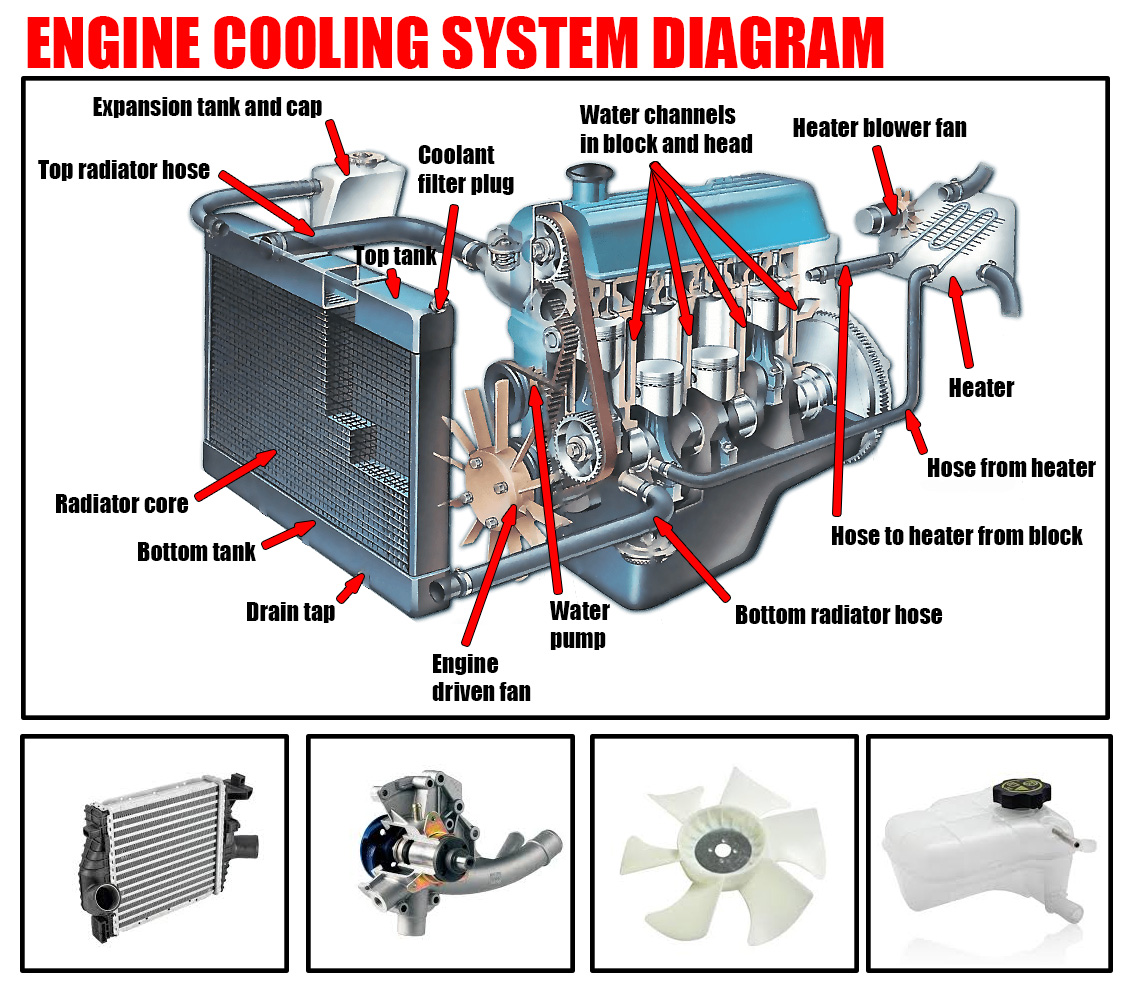
The engine cooling system plays a crucial role in maintaining a car engine’s operational efficiency and longevity. As a car engine runs, it generates significant heat, which needs to be continuously managed to prevent engine damage. The cooling system achieves this by circulating a coolant liquid, typically a mixture of water and antifreeze, through dedicated cooling passages.
Water-Cooled Systems
In most vehicles, the engine is cooled using a water-cooled system. The engine block and cylinder head feature interconnected coolant channels that allow the coolant to flow through them. At the top of the cylinder head, these channels converge into a single outlet. From here, the coolant is pumped out of the engine by a pump driven by a pulley and belt connected to the crankshaft.
The hot coolant is then directed to the radiator, a specialized heat exchanger designed to dissipate unwanted heat. The radiator transfers this heat to the air stream, cooling the liquid, which then returns to an inlet at the bottom of the engine block. This cooled liquid is recirculated through the channels, maintaining a stable engine temperature.
The Role of the Radiator
The radiator is connected to the engine via rubber hoses and consists of a top and bottom tank linked by a core made up of numerous fine tubes. These tubes pass through a stack of thin sheet-metal fins, which provide a large surface area for rapid heat loss to the passing air. In older vehicles, the radiator tubes run vertically, but modern cars with lower profiles often feature crossflow radiators with tubes running horizontally.
Pressure Management and Boiling Prevention
Maintaining the coolant below its boiling point is critical to the cooling system’s effectiveness. The coolant in an engine at its normal operating temperature is just below the boiling point. To prevent the coolant from boiling, the system increases the pressure, which raises the boiling point of the liquid.
This pressure is regulated by the radiator cap, which contains a pressure valve. If the pressure exceeds a certain threshold, the valve opens, allowing coolant to escape through an overflow pipe. In older systems, this could lead to a continual, slight loss of coolant, necessitating periodic top-ups.
Modern Sealed Systems
Many modern vehicles feature a sealed cooling system designed to minimize coolant loss. In these systems, any overflow of coolant is directed into an expansion tank. As the engine cools and the coolant contracts, the liquid is drawn back into the engine from the expansion tank, maintaining a consistent coolant level without the need for frequent topping up.
Understanding the components and operation of an engine cooling system is essential for proper vehicle maintenance. A well-functioning cooling system ensures that the engine remains within its optimal temperature range, preventing overheating and extending the engine’s lifespan.