
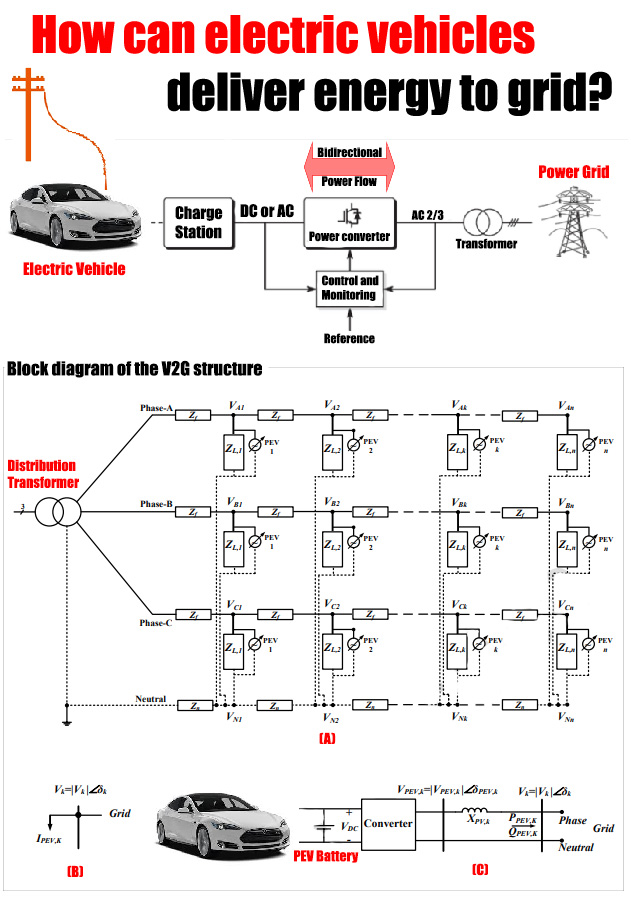
We are talking about V2G below. V2G is the system that gives excess charge in your EV back to the grid. Single line diagram helps you to understand how it works.
Plug–in electric vehicles (PEVs) that are connected to residential distribution networks can not only take the energy but they can be able to support networks as small distributed generation units by transferring the energy stored in their battery into the grid. It means that PEVs will be used as temporary local dispersed generation units when parked at home during the day.
First, you must charge the EV battery when the price is lower. If you do not use the vehicle, you can sell this energy back to the grid later, at a higher price. Then you must charge the EV battery again when the price cycle falls.
In practice, the price on the grid changes throughout the day, depending on the demand or surplus. Usually, the price is low at night and high at peak periods (mid-day and early night). So if you charge your car at night and deliver some of the charges back to the grid during peak periods, you can both earn some money and mitigate the demand (and surplus) on the grid.
The EV battery is an energy source that much like a solar panel can be fed back the energy into the grid via an inverter.
Single line diagram
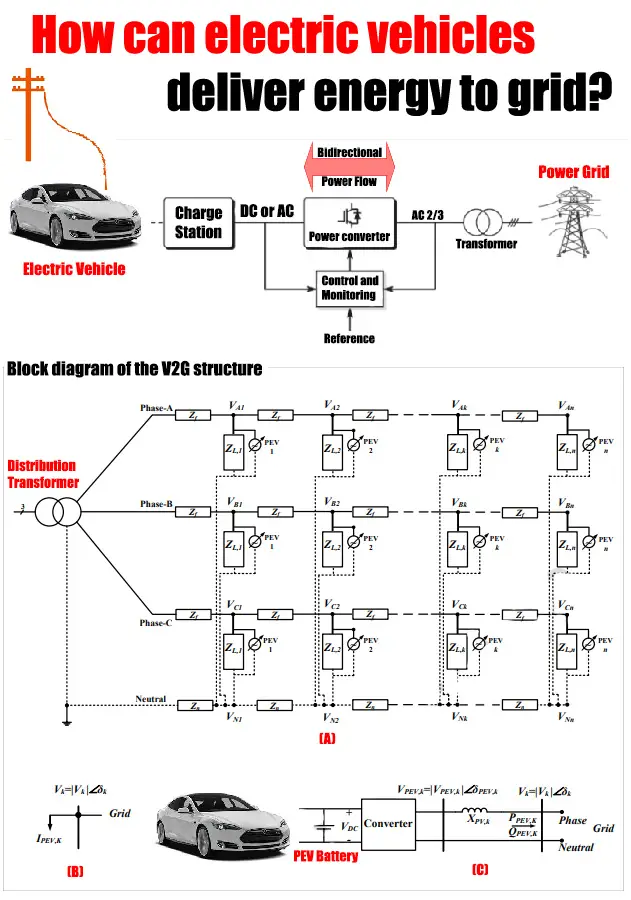
- Single line diagram of one phase of the studied distribution feeder, (B) Schematic diagram of PEV in G2V mode, (C) Schematic diagram of PEV in V2G mode.