Explorer
The Explorer is one of America’s best-selling SUVs, but its two most recent generations tell very different reliability stories – as covered in our full Ford reliability and maintenance guide, the platform and transmission changed enough between them that treating them as one continuous model would miss what actually matters. This guide covers the Explorer by generation and component: what to expect, and what to check before buying.

Ford Recalls & Safety Notices
Model years 2017–2026
LIVE DATA · SOURCE: NHTSA| Date | Vehicle | Campaign | Component | Summary |
|---|---|---|---|---|
| 2026-09-09 | Ford Explorer MY 2026 | 26V581000 ↗ | AIR BAGS:FRONTAL | Ford Motor Company (Ford) is recalling certain 2026 Explorer vehicles. The active vent on the passenger side may not open as intended, preventing the air bag from deploying properly.Consequence An air bag that does not deploy as intended increases the risk of injury in a crash. Remedy Dealers will replace the passenger air bag module, free of charge. Owner notification letters are expected to be mailed September 25, 2026. Owners may contact Ford customer service at 1-866-436-7332. Ford's number for this recall is 26S65. Vehicle Identification Numbers (VINs) involved in this recall became searchable on NHTSA.gov on September 14, 2026. |
| 2026-08-25 | Ford Explorer MY 2026 | 26V548000 ↗ | ENGINE AND ENGINE COOLING:ENGINE:HARD PARTS INTERNAL/MECHANICAL | Ford Motor Company (Ford) is recalling certain 2026 Explorer, Bronco, Bronco Sport, Mustang, and Ranger vehicles. The engine piston domes may have been manufactured incorrectly, which can result in piston dome failure and lead to a loss of drive power.Consequence An unexpected loss of drive power increases the risk of a crash. Remedy Dealers will inspect the engine pistons and replace the engine long block, if necessary, free of charge. Interim letters, notifying owners of the safety risk, were mailed September 3, 2026. Additional letters will be sent once the remedy is available, anticipated in December 2026. Owners may contact Ford customer service at 1-866-436-7332. Ford's number for this recall is 26S61. Vehicle Identification Numbers (VINs) involved in this recall became searchable on NHTSA.gov on August 28, 2026. |
| 2026-08-13 | Ford Explorer MY 2026 | 26V532000 ↗ | ENGINE AND ENGINE COOLING:ENGINE:HARD PARTS INTERNAL/MECHANICAL | Ford Motor Company (Ford) is recalling certain 2026 Explorer vehicles equipped with a 2.3L engine. The engine connecting rod bearings may seize, which can result in engine failure.Consequence Engine failure can result in a loss of drive power, increasing the risk of a crash. In addition, bearing failure may cause a breach in the engine block, allowing oil to leak, increasing the risk of a fire. Remedy Dealers will replace the engine long blocks, free of charge. Owner notification letters were mailed August 25, 2026. Owners may contact Ford customer service at 1-866-436-7332. Ford's number for this recall is 26S58. Vehicle Identification Numbers (VINs) involved in this recall became searchable on NHTSA.gov on August 18, 2026. |
| 2026-07-21 | Ford Explorer MY 2026 | 26V470000 ↗ | SEATS:FRONT ASSEMBLY:POWER ADJUST | Ford Motor Company (Ford) is recalling certain 2025-2027 Explorer and Lincoln Aviator vehicles. An unoccupied driver's seat may recline unintentionally during certain scenarios, such as remote unlock or remote start.Consequence Unexpected movement of the driver’s seat back may trap a second-row occupant, increasing the risk of injury. Remedy Dealers will disable the driver seat module (DSM) feature until parts are available. Once available, the motor will be replaced. Repairs will be performed free of charge. Owner notification letters were mailed September 3, 2026. Owners may contact Ford customer service at 1-866-436-7332. Ford's number for this recall is 26S53. |
| 2026-07-14 | Ford Explorer MY 2026 | 26V451000 ↗ | SEATS:MID/REAR ASSEMBLY | Ford Motor Company (Ford) is recalling certain 2020-2027 Aviator and 2020-2026 Explorer vehicles. The switch for the easy-entry second-row outer seats may bind or stick, resulting in the seats unlatching, tipping, or sliding unexpectedly.Consequence A seat that moves unexpectedly may not properly restrain an occupant during a crash, increasing the risk of injury. Remedy Dealers will inspect and replace the bezel around the switch as necessary, free of charge. This will be a phased campaign, with the remedy becoming available in different phases based on model and model years. Interim letters explaining the safety risk were mailed August 19, 2026. Additional letters will be sent once the remedy is available, anticipated in January 2027. Lincoln Aviator owner notification letters were mailed August 21, 2026. Owners may contact Ford customer service at 1-866-436-7332. Ford's number for this recall is 26S52. This recall expands Recall 25V393. Vehicle Identification Numbers (VINs) involved in this recall became searchable on NHTSA.gov on July 16, 2026. |
Generations Worth Knowing
- 5th generation, CD4 platform (2011-2019) – front-wheel-drive-based, paired with a 6-speed 6F55 automatic. The defining issue on this generation is torque converter clutch solenoid failure, producing a shudder under light acceleration. Steering is also a documented weak point across this generation – a federal complaint cluster of over 3,300 steering-related reports spans 2011-2019 production, typically surfacing between 45,000 and 270,000 miles, with repair costs around $4,500. 2011 specifically stands out as a weak year, with nearly 1,200 owner complaints on federal record.
- 6th generation, CD6 platform (2020-present) – a major architectural shift to a rear-wheel-drive-based platform (with all-wheel drive standard on most trims), paired with a 10-speed 10R60 automatic. This generation had one of the roughest launches in the industry: roughly 30 recalls in its first year alone.
Common Problems by Component
Transmission (6th Generation)
The 10R60 automatic is the most reported defect on 2020-and-later Explorers: gear hunting between 2nd and 3rd at low speed, jerky shifts, and abrupt downshifts, tied to five separate recalls. The 2020 model year alone accounts for over 1,200 powertrain-related complaints on federal record, with transmission issues making up roughly 45% of them. A full 10-speed rebuild commonly runs $3,800-5,200.
Rollaway and Camera Recalls
A widely-reported unintended-movement-while-parked issue affects over 250,000 6th-generation vehicles – Ford’s proposed fix has been contested by NHTSA, so confirm current recall status rather than assuming it’s resolved. Separately, a rearview camera defect affecting over 700,000 vehicles across six recall rounds has proven a recurring problem that’s been difficult to fully resolve.
Engine (6th Generation)
A 3.0L V6 valve failure prompted a 2024 recall of roughly 90,000 vehicles, with the risk of catastrophic engine damage if not addressed. Separately, 2020-2021 Explorer ST models with the 3.0L engine have a documented pattern of catalytic converter cracks and defective exhaust manifold welds that can let exhaust gas seep into the cabin – a burning smell during hard acceleration is worth investigating immediately given the carbon monoxide risk. More recent model years have seen smaller-scale issues: incorrectly machined connecting rods and an incorrect EGR valve on some 2025 models, and an oil leak traced to a cylinder head plug on some 2026 models.
Steering
Steering is the single most-reported problem area across the Explorer’s federal complaint history overall, spanning both generations – power steering failure or abnormal stiffness is the most common specific complaint.
Recommended Maintenance
| Interval | What to Check |
|---|---|
| Every 8,000-12,000 km (~5,000-7,500 mi) | Engine oil and filter change |
| Every 40,000 km (~25,000 mi) | Transmission fluid and cooler line inspection – especially important on the 10R60, given its documented gear-hunting pattern |
| Every 80,000 km (~50,000 mi) | Power steering system inspection, water pump and coolant check, full diagnostic scan |
Frequently Asked Questions
Is the Ford Explorer reliable?
It’s a mixed picture, especially on the 2020-and-later generation, which had a genuinely rough launch with around 30 recalls in its first year. Steering issues span both generations. Confirm current recall status by VIN regardless of which generation you’re considering.
What’s the best Explorer year to buy?
Later 6th-generation production (2024+) benefits from running fixes to the early transmission and recall issues, though new smaller-scale issues have continued to surface each model year. If you’d rather have a more settled, better-understood platform, a well-documented late 5th-generation (2017-2019) example is a reasonable alternative.
Should I avoid the 2020 Explorer specifically?
It’s worth extra caution – 2020 has the highest concentration of powertrain complaints on federal record for this generation, nearly half of them transmission-related. Confirm the relevant recalls have been completed before buying.
Ford Explorer Fuse Box Diagram
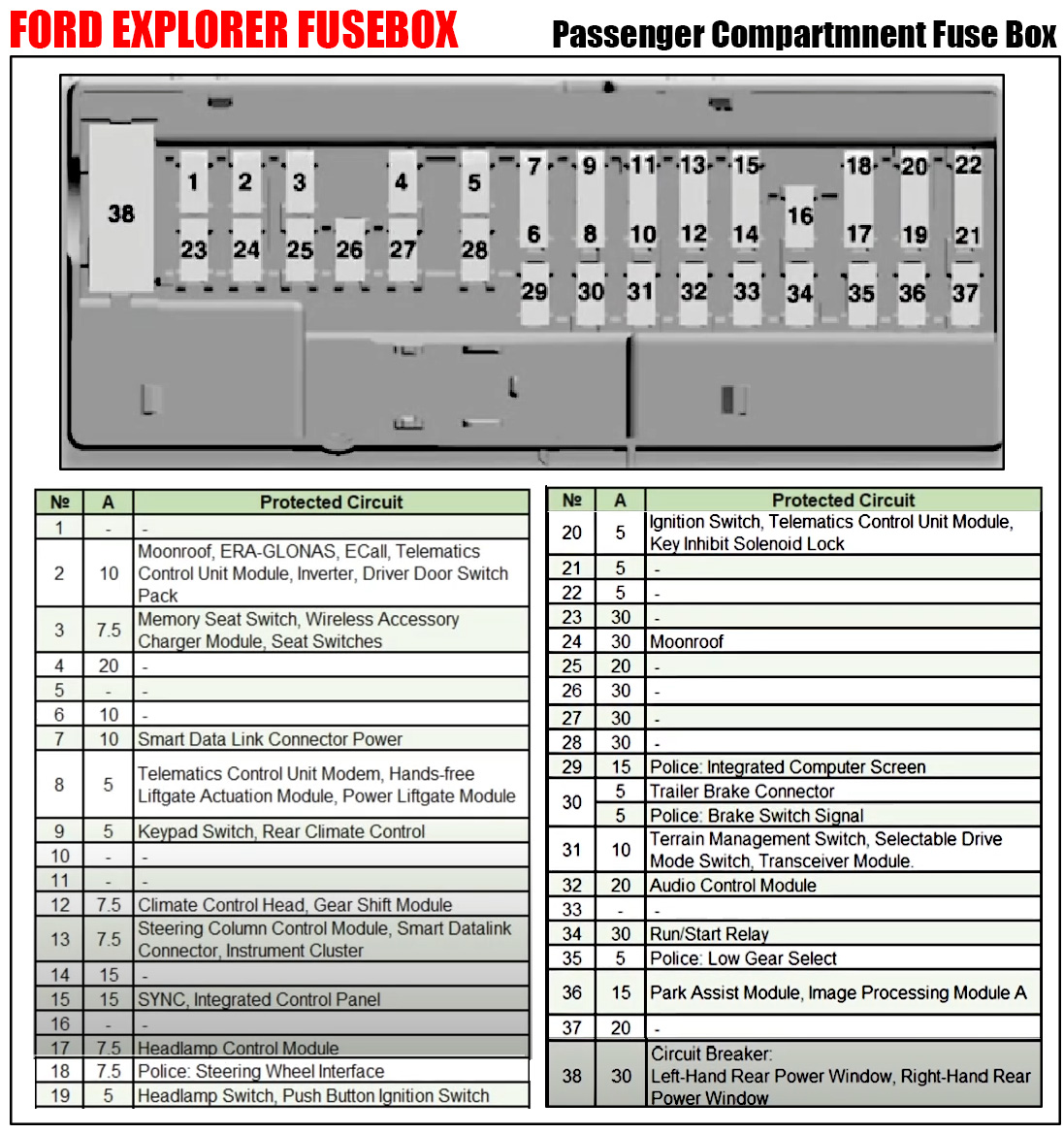
The engine compartment fusebox is under the driver-side leaf screen in the engine compartment.