
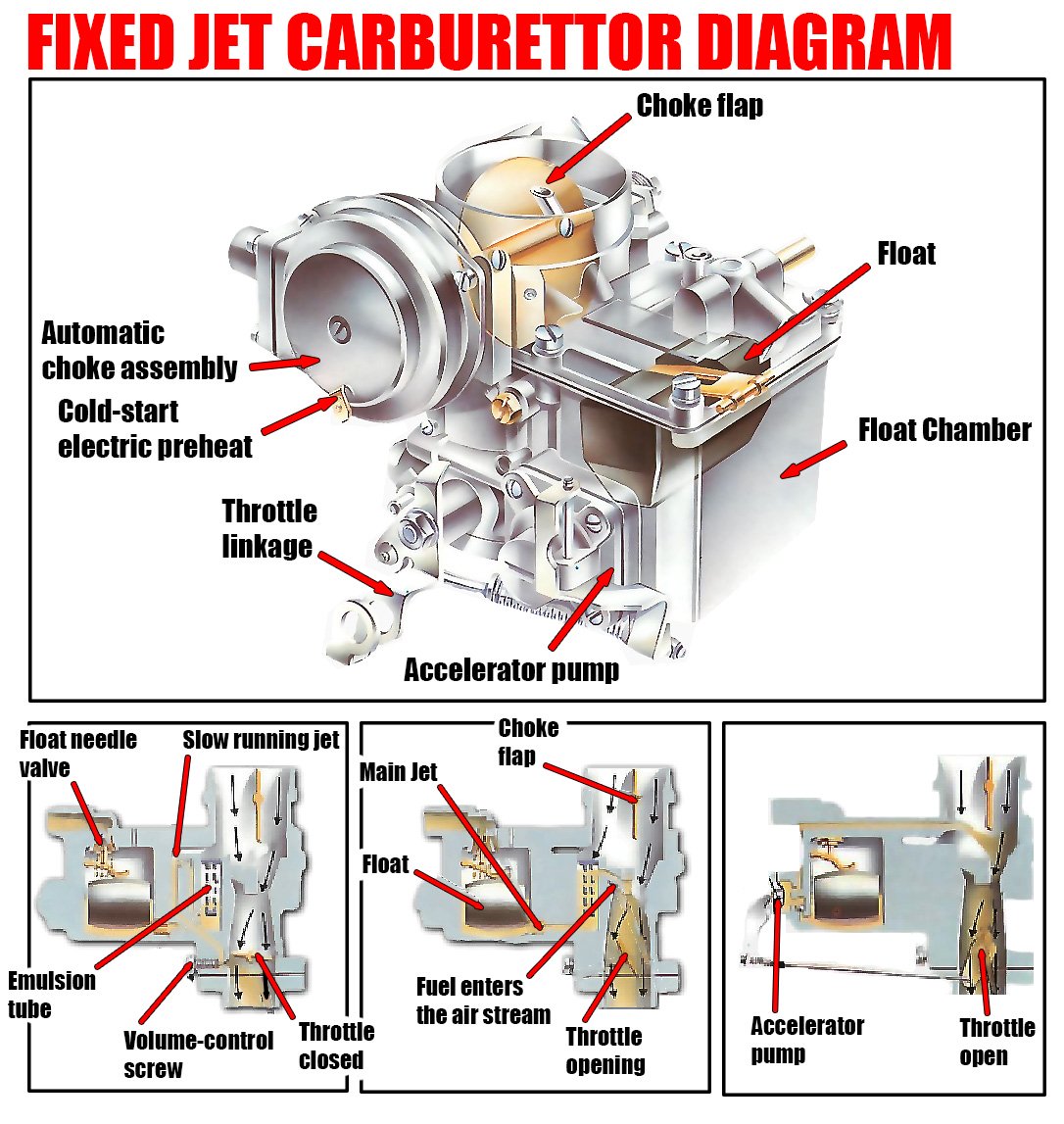
This description pertains to a typical fixed-jet carburettor, specifically a Solex model, where the air flows from top to bottom, categorizing it as a down-draught carburettor.
- With the engine idling and the throttle nearly closed, a minimal amount of fuel-air mixture flows past the throttle flap, also known as the butterfly valve, through small openings on either side.
- When the engine operates at high speeds with the throttle wide open, the butterfly valve aligns almost vertically, permitting a free flow of the fuel-air mixture.
- During rapid acceleration, the accelerator pump activates to provide a richer fuel mixture to the engine.
The fixed-jet carburettor is akin to the simpler variable-jet type (refer to How variable-jet carburettors work) in that it includes a venturi—a narrowed passage—where air passes through en route to the engine.
The partial vacuum created by the increased air speed within the venturi draws fuel through a jet, allowing it to blend with the air.
Likewise, a throttle flap connected to the accelerator pedal manages the airflow, controlling the engine’s speed.
Situated above the throttle is a choke flap that partially restricts airflow, enriching the mixture for engine startup. As with all carburettors, a float chamber ensures a consistent supply of fuel.
Changing from jet to jet
Transitioning from one jet to another, the fixed-jet carburettor utilizes open jets to manage the flow of fuel. This necessitates the presence of multiple jets of varying sizes to accommodate the diverse fuel requirements at any given time.
During engine idling, minimal fuel is necessary due to the restricted airflow through the nearly closed throttle—insufficient to draw fuel through the main jet within the venturi.
However, a significant vacuum forms beneath the throttle flap, where a small slow-running jet is integrated into the often intricate slow-running (idling) circuit. This vacuum draws a small amount of fuel through this jet, sustaining the engine’s idle state.
When the throttle is opened, the airflow accelerates swiftly. An accelerator pump connected to the throttle delivers a quick burst of additional fuel, momentarily enriching the mixture to prevent a flat spot—an instance of hesitation—caused by the carburettor’s inability to promptly provide the proper mixture to meet sudden power demands.
The force driving this burst originates from a rubber diaphragm exposed to atmospheric pressure on one side. The normal air pressure, exceeding the partial vacuum within the carburettor, pushes the diaphragm inward against a piston, which pumps the fuel.
Subsequently, the rapid airflow creates a vacuum in the venturi, which extracts fuel from the main jet. The faster the airflow, the more fuel is drawn out. Most carburettors feature one or more non-return valves, typically a small ball seated on a conical opening, to prevent the unnecessary backflow of fuel.