
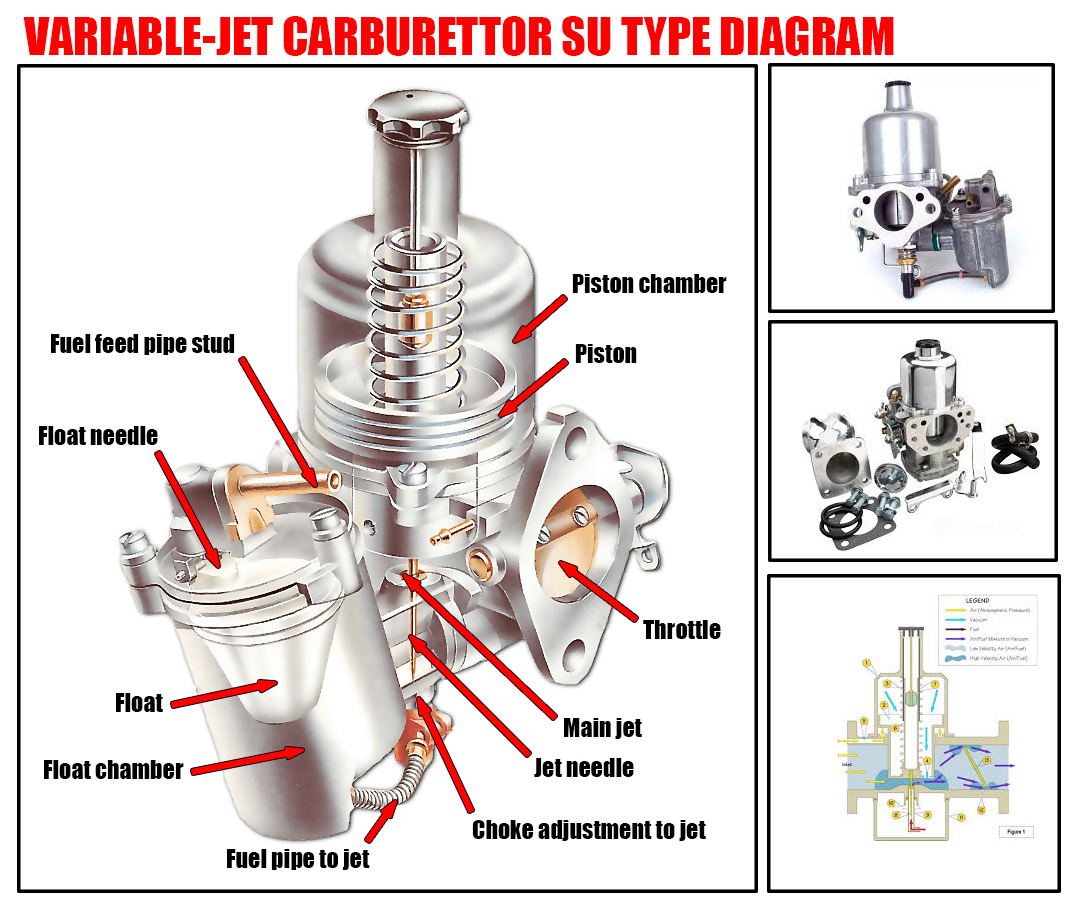
SU Carburettor Functionality
An SU carburettor is integral in managing the air-fuel mixture that an engine needs for optimal performance. It achieves this by spraying fuel through a jet into a moving airstream, which aids in the vaporization of the fuel to create an explosive mix. The speed of the engine dictates the amount of air intake, which passes through a narrowed passage known as the venturi. This design accelerates the airflow, creating a low-pressure area that sucks fuel from the jet into the airstream.

- Minimal vacuum exists within the piston chamber.
- When the throttle butterfly is entirely open, the engine is at maximum throttle.
- Engaging the choke results in the jet being lowered, permitting increased fuel intake.
Engine Speed and Throttle Control
Engine speed is controlled by a throttle—a movable circular flap connected to the accelerator pedal. This flap adjusts the airflow by partially blocking the venturi, thus allowing for variable amounts of air to enter the carburettor. Ensuring the right fuel-to-air ratio is crucial, and this is achieved through a variable jet mechanism.
Variable-Jet Carburettor Design
The SU carburettor features a variable jet system where a tapered needle, attached to a piston, partially blocks the fuel jet. The piston can move up and down in a chamber above the jet. At low engine speeds or when idling, the low vacuum in the inlet manifold and a light spring keep the piston at the bottom, minimizing fuel flow by blocking the jet with the needle. As the throttle opens and the engine draws in more air, the increased vacuum in the inlet manifold pulls the piston up, unblocking the jet and allowing more fuel to flow.

Response to Acceleration and Fuel Mixture Stability
During sudden acceleration, a rush of air into the inlet manifold reduces the vacuum momentarily. This could potentially lower the piston, restricting fuel flow. However, to prevent this sudden change in the mixture, an oil-filled damper is attached to the piston. This damper slows the piston’s movement, ensuring the mixture remains consistent for smooth combustion.
Cold Start Mechanisms
Starting an engine from cold requires a richer fuel mixture. Variable-jet carburettors achieve this by temporarily lowering the jet, allowing more fuel to bypass the needle. Some carburettors atomize neat fuel through rotating discs with progressively larger holes. In contrast, fixed-jet carburettors use a choke flap to restrict air supply. Both systems enrich the mixture for a cold start.
Choke Control Systems
Choke systems can be either manual or automatic. Manual chokes are controlled via a dashboard, steering column, or floor pan lever. Automatic chokes utilize a bimetallic strip attached to the choke lever. As the engine heats, the strip expands unevenly due to the different metals’ expansion rates, gradually moving the choke lever from ‘on’ to ‘off.’
Float Chamber and Fuel Regulation
A steady fuel flow is maintained by a float chamber attached to the carburettor. The chamber contains a pivoted float that regulates fuel entry through a needle valve. This ensures that the fuel level remains constant, providing the carburettor with a reliable fuel supply for efficient engine performance.