
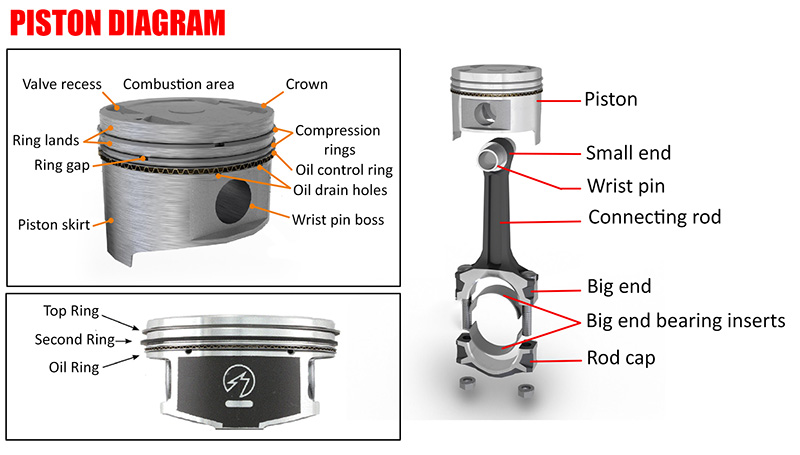
A piston has two main sections: the crown (or head) and the skirt, usually cast or forged as one piece from an aluminum alloy for its combination of light weight and good thermal conductivity.
Crown
The crown is the top surface that faces combustion directly. Its shape (flat, domed, or dished) affects compression ratio and how the air-fuel mixture burns. Just below the crown surface, the ring belt contains the ring grooves – recessed channels that hold the piston rings. Most automotive pistons carry three rings: two compression rings that seal combustion pressure against the cylinder wall, and one oil control ring that scrapes excess oil back into the sump.
Pin boss and skirt
Below the ring belt, two pin bosses (or pin bores) hold the piston pin (wrist pin), which connects the piston to the small end of the connecting rod. The skirt is the lower, mostly hollow section that guides the piston’s travel inside the cylinder bore and manages the side-thrust load from the connecting rod’s angle as the crankshaft rotates. Skirts are often profiled or partially cut away to reduce weight and to clear the rotating crankshaft counterweights.
Because aluminum expands more than the cast-iron or aluminum cylinder it runs in, piston skirts are typically machined slightly oval (cam-ground) and tapered so they seat correctly only once the engine reaches operating temperature – part of why a cold engine can sound different than a warm one.