
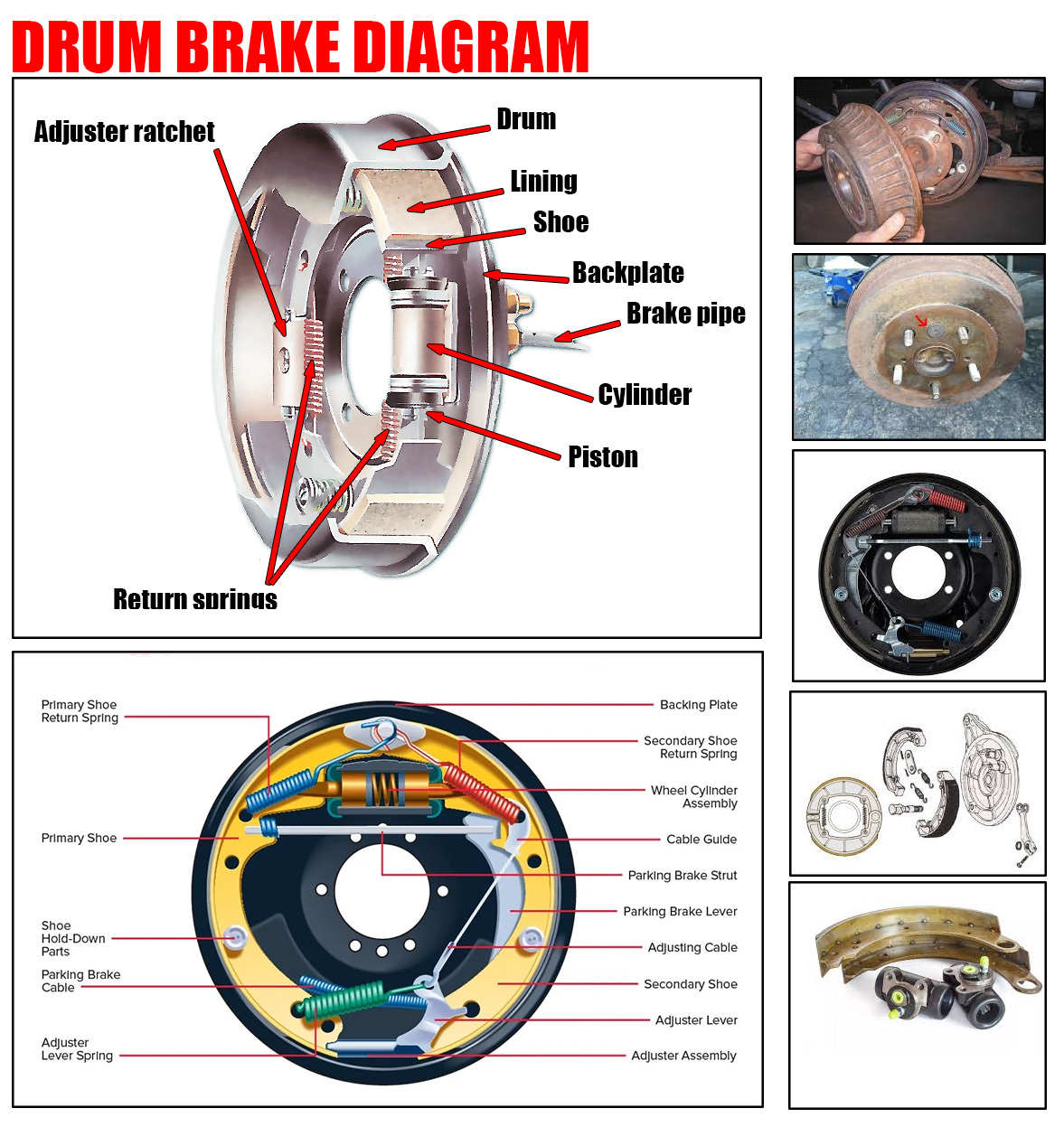
Drum brakes are a classic yet effective component of automotive braking systems. Central to their design is a hollow drum that spins in unison with the wheel, its open rear end sealed by a fixed backplate. Attached to this backplate are two curved shoes equipped with friction linings.
When the brake is applied, hydraulic pressure propels pistons within the wheel cylinders, pressing the friction linings of the shoes against the inner surface of the drum. This action slows or halts the wheel’s rotation. Each brake shoe features a pivot at one end and a piston at the other. In a leading shoe design, the piston is positioned at the shoe’s leading edge concerning the drum’s rotational direction. This configuration ensures that the drum’s rotation pulls the leading shoe more tightly against the drum, enhancing the braking performance.
In some setups, drum brakes utilize twin leading shoes, each powered by its hydraulic cylinder. Others employ a combination of one leading and one trailing shoe, with the pivot positioned at the front. This arrangement allows a single cylinder, with pistons at each end, to drive the two shoes apart. While this design is less potent than the twin leading shoe system, it’s more straightforward and is commonly found in rear brakes.
Regardless of the type, return springs are integral to the system, retracting the shoes slightly once the brakes are released. The adjuster keeps shoe travel to a minimum. Older drum brake systems require manual adjusters that need occasional tweaking as the friction linings wear down. Modern systems, however, feature automatic adjusters that use a ratchet mechanism for self-adjustment.

One limitation of drum brakes is their tendency to fade during repeated, rapid use. The resulting heat build-up can diminish their effectiveness until they cool. In contrast, disc brakes, with their more open design, are less susceptible to this kind of fading.