
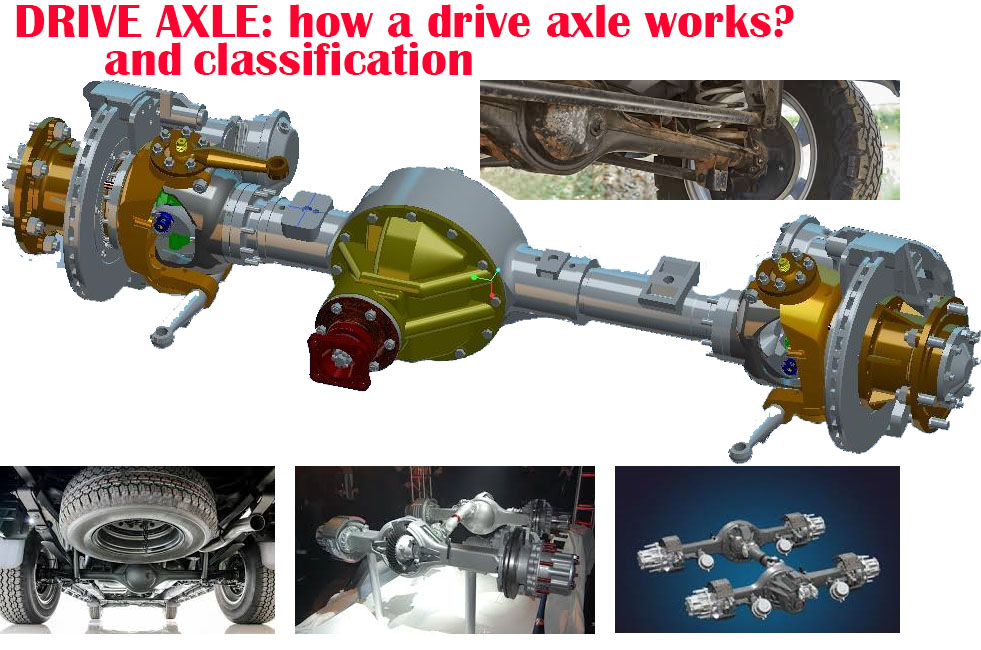
The drive axle transmits torque from the propeller shaft to the driving wheels, and also carries the vertical, longitudinal, and transverse forces passed between the road and the vehicle’s frame or body.
Live (rigid) vs. split drive axles
With dependent wheel suspension, the drive axle is built as a single rigid hollow beam housing the final drive gear, differential, and axle shafts, connecting both wheels directly – so movement on one side affects the other. With independent suspension, the axle housing is split at the differential, and each wheel connects through its own swinging half-shaft, letting the wheels move independently of each other.
CV joints on independent drive axles
Modern independent drive axles – the layout used on the vast majority of front-wheel-drive cars and many independent-rear-suspension vehicles – use constant velocity (CV) joints at each end of the half-shaft rather than the simpler universal joints found on older rigid-axle trucks. A CV joint keeps rotational speed constant through a wide range of angles, which a U-joint cannot do without introducing vibration – important since the half-shaft has to flex both with suspension travel and with steering angle on the front axle.
Signs of drive axle trouble
On CV-jointed independent axles, the earliest warning is usually a torn rubber CV boot leaking grease onto the inside of the wheel, followed by a clicking or popping noise when turning as the joint runs dry and its bearings wear. A clunk on acceleration or deceleration, or vibration that worsens with speed, point to a worn inner joint. On rigid live axles, listen instead for gear whine or clunk from the differential housed inside the beam itself.