
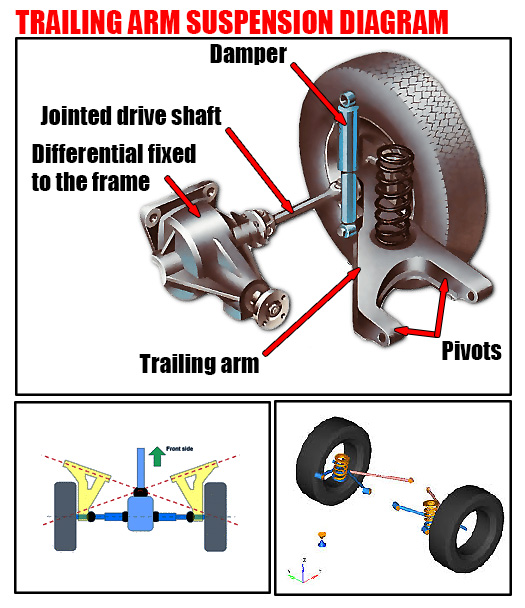
A trailing-arm suspension is a type of automotive suspension system predominantly used in rear-wheel-drive vehicles. This system is particularly favored for its ability to maintain wheel alignment and stability, even under challenging driving conditions. To understand the mechanics and advantages of this suspension type, it is essential to explore its structure, components, and functionality.
Structural Overview
The trailing-arm suspension features a design where the arm is connected directly to the rear wheel hub. This arm extends rearward, forming a V-shape as it broadens into two arms that pivot on the vehicle’s frame. These pivot points are crucial as they allow the suspension to move vertically, absorbing shocks and maintaining contact between the tires and the road surface.
One of the critical aspects of this design is the fixed differential. In this configuration, the differential is securely attached to the vehicle’s frame. This setup ensures that the differential remains stationary, with only the drive shafts responsible for transmitting power to the wheels. The drive shafts are equipped with universal joints, which provide flexibility in accommodating the vertical motion of the suspension while maintaining a consistent power delivery to the wheels.
Comparative Analysis: Trailing Arm vs. Leading Arm
It’s important to differentiate between a trailing-arm and a leading-arm suspension, as they serve distinct purposes and are used in different parts of the vehicle. While the trailing-arm suspension is employed at the rear, a leading-arm suspension is utilized at the front. In a leading-arm design, the wheel is positioned ahead of the pivot point, contrasting with the trailing-arm where the wheel is behind the pivot. This fundamental difference affects the handling characteristics of the vehicle, with the leading-arm generally providing sharper steering responses, which is why it is often reserved for the front suspension.

Swing Axles and Their Functionality
In some vehicles, swing axles are used either at the front or rear, depending on the design. The concept behind swing axles is somewhat akin to dividing a beam axle in half, where each half is attached to pivots on the vehicle’s frame. This design allows for independent movement of each wheel, improving ride comfort and traction.
The half-axle in a swing axle system is typically broadened into a V-shape, similar to the trailing-arm suspension, but with distinct differences in functionality. The front and rear pivots of the V-shaped half-axle are designed to prevent the axle from twisting during operation. This structural integrity is crucial for maintaining stability and ensuring that the wheels maintain proper alignment, particularly during cornering or when navigating uneven terrain.
Conclusion
The trailing-arm suspension is a sophisticated and reliable design, particularly well-suited for rear-wheel-drive vehicles. Its ability to maintain wheel alignment, combined with the stationary differential and flexible drive shafts, ensures a smooth and stable ride. When compared to other suspension types, such as the leading-arm or swing axle systems, the trailing-arm offers a unique blend of stability, comfort, and performance. This makes it a popular choice for both standard and high-performance vehicles, where maintaining precise control over the rear wheels is paramount.
This overview provides a foundational understanding of the trailing-arm suspension, highlighting its key components and how they contribute to the overall handling and performance of a vehicle. Whether for academic study or practical application, this system remains a vital aspect of automotive engineering.